Waka Waka EA — Grid Robot with 7,500% Track Record | Free Download

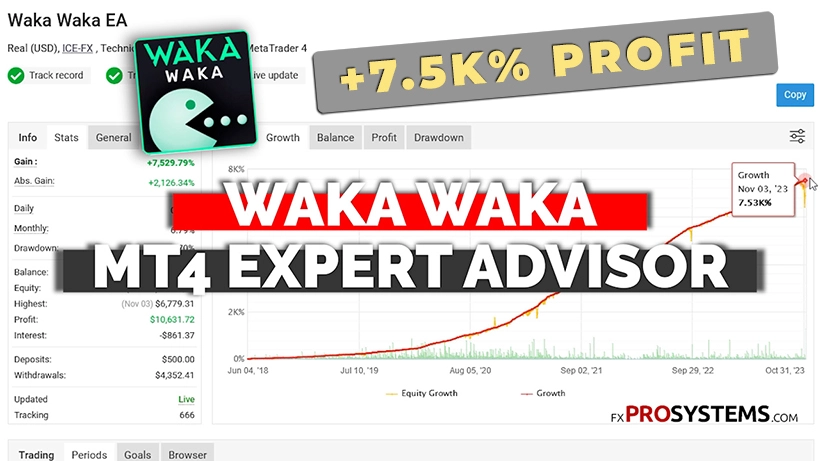
Waka Waka EA is a grid robot boasting an eye-catching 7,500%+ profitability, backed by a double-verified MyFxBook track record spanning over 5.5 years. It's multicurrency by design — you can technically run it on any pair, though it will only trade the pairs specified in its settings — and offers lot-sizing options ranging from fixed lots to a high-risk dynamic mode targeting up to 120% annual growth. Whether those numbers hold up in practice is exactly what we'll dig into in this review
Characteristics of the Waka Waka EA
- Official website: waka-waka-ea
- Platform: Metatrader4
- EA version: 4.59
- Currency pairs: AUDCAD, AUDNZD, NZDCAD
- Trading Time: Around the clock
- Timeframe: M15
- Minimum deposit: $500 (or 500 USD cents, best conditions here ➔ ProCent)
- Recommended broker: Roboforex | XM | VT Markets
Trading algorithm
The entry logic is contrarian, not breakout-following, even though it might look that way at first glance. Waka Waka calculates Bollinger Bands manually — upper band at MA(35) + 2×StdDev, lower band at MA(35) − 2×StdDev — and combines that with RSI(20). A buy signal requires price to break below the recent swing low and RSI to be oversold (below 35 by default); a sell signal requires the mirror image: a break above the recent swing high with RSI overbought (above 65). Trades are only evaluated on M15 candle closes, not on every tick.



In plain terms: the EA waits for what looks like an accelerating move — price breaking a recent extreme — and then bets against it, expecting a pullback. That's a reasonable explanation for why the first trade in a sequence sometimes ends up fighting a trend that keeps going: it's a mean-reversion entry by design, and mean-reversion entries are, by definition, sometimes early.
What happens next is the grid. On default settings, up to 9 trades can stack, spaced 35 pips apart, with lot size scaling by stage: the 2nd trade matches the initial lot (1.0x), the 3rd–5th trades roughly double it (2.0x), and the 6th trade onward settles at 1.6x. It's a gentler curve than a classic doubling martingale (2-4-8-16...), but it's still meaningfully increasing exposure against an open loss, level after level, up to 9 times over. This is the mechanism the developer herself describes plainly in a reply to a critical review:<
Any grid trading system will eventually blow up the account if no risk management is applied.
That's not a hypothetical from a critic — it's Valeriia Mishchenko's own words, and it's the honest starting point for reading everything below.
A few other pieces worth knowing about, confirmed directly from the EA's own settings: a news filter that blocks new baskets ahead of high-impact events like FOMC, an optional SPX500-based stock-market-crash filter (off by default), a pause window around rollover, and a trailing stop that activates 10 pips into profit. Newer versions (4.x) also add a "ML-Based Pattern Filter" on top of the original Bollinger/RSI logic — not present in earlier source I reviewed, so it appears to have been added in a later update.
A brief video review of Waka Waka MT4 EA:
Official website ➔ Waka Waka EA
Testing
Since the EA is recommended for AUDCAD, AUDNZD, and NZDCAD, I tested it exclusively on these three pairs, going back to 2008 and covering several different risk settings. The starting deposit for all tests was $10,000. Here are the results:
AUDCAD Fixlot 2008-2023: 
AUDCAD High Risk Set 120% annual 2008-2023: 
AUDCAD Mid Risk Set 40% annual 2008-2023: 
AUDNZD Fixlot 2008-2023: 
AUDNZD High Risk Set 120% annual 2008-2023:

AUDNZD Mid Risk Set 40% annual 2008-2023: 
NZDCAD Fixlot 2008-2023: 
NZDCAD High Risk Set 120% annual 2008-2023: 
AUDNZD Mid Risk Set 40% annual 2008-2023: 
All tests were performed with the modeling quality of 99.9% using TDS2 software
I should note that the AUDCAD results above are somewhat flattering: I cut the test window off in June 2023, since the EA enters a prolonged drawdown shortly after and the equity curve looks considerably less encouraging beyond that point:

The EA managed to survive, but the drawdown hit a brutal 95% — a figure you need to be mentally prepared for whenever you run grid-based EAs. Based on this result, I wouldn't consider the High or Significant risk presets safe to use, though to be fair, this was an isolated case across 15 years of testing on three pairs.
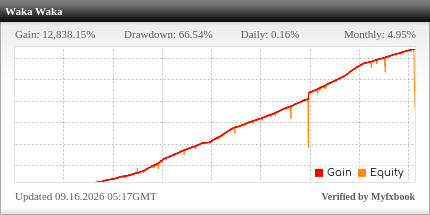
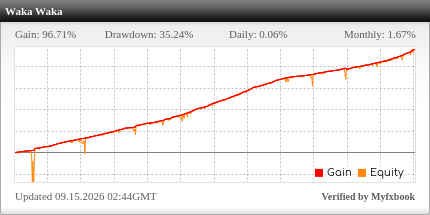
Two independently verified accounts on MyFxBook back up the numbers:
The flagship account has 5.5+ years of live, double-verified trading history, with over 7,500% total profit and 65 consecutive profitable months — an unusually long and clean streak for a grid EA.
A second, more modest account, run by a different trader, has been live since May 2023 and gives a useful sense of how the EA performs over a shorter, more recent stretch.
What real users are reporting
Waka Waka's MQL5 review section is unusually polarized for a 4.2-star product — genuine long-term fans sit right next to detailed accounts of blown accounts, and it's worth reading both sides before trusting the headline rating.
On the positive side: several reviewers report years of stable use, and the developer is widely described as responsive and hands-on with configuration help.
On the other side, the pattern repeats across multiple independent reviewers:
- One user reported the EA crashing and wiping their account after holding multiple losing NZDCAD positions open for over a month
- Another described both 1% and 1.5% risk settings as ending in "exploding" the account
- A detailed critical review reported drawdowns in the 40–50% range at medium risk — well beyond what the backtest marketing implies — and described the backtests shown by the seller as misleading
- The Max Floating Drawdown % parameter ships at 100.0 by default — confirmed directly from the v4.59 fix settings panel — even when Lot-sizing Method is set to the "Low Risk" preset. In effect, there's no real floating-drawdown ceiling unless you set this yourself
- Another called it plainly a "high-risk asymmetric martingale EA"
The developer's standard response to criticism is consistent: risk management options exist in the EA, and using them correctly makes account loss "impossible" — technically true if configured conservatively, but it puts the burden of avoiding disaster entirely on the buyer's own settings, not on anything the EA does by default.
| What reviewers reported | Source |
|---|---|
| Account wiped after a month-long losing NZDCAD position | MQL5 review, 2024 |
| 1% and 1.5% risk both described as account-exploding | MQL5 review |
| 40–50% real drawdown at medium risk, backtests called misleading | MQL5 review |
| Max Floating Drawdown % defaults to 100.0 — confirmed in the v4.59 settings panel, even under the Low Risk preset | Verified directly from EA settings |
| Multiple users report years of stable results | MQL5 reviews (positive) |
This lines up with the 95% drawdown my own backtest already surfaced above — this isn't a one-off testing artifact, it's a pattern independently reported by real buyers on the EA's own review page.
Input parameters of the Waka Waka EA v4.43
The Waka Waka EA's settings are straightforward — you shouldn't run into any confusion here.
These are the settings:
- Money Management & Risk settings
- Time settings
- Strategy
- Grid settings
- Others
I only adjusted two parameters: Lot-Sizing Method and Dynamic Lot (Balance/Equity based). Everything else was left at default.
As always, for stable performance, run the EA on a VPS with a reputable zero-spread ECN broker, and never trade with money you can't afford to lose. Keep in mind this EA relies on a high-risk money management method.
If the grid-based risk here isn't for you, it's worth knowing this developer (Valeriia Mishchenko) also makes Night Hunter Pro — a genuinely different, rule-based night scalper with no grid or martingale. It comes with its own set of concerns (see our review), but at least the underlying mechanics are different from what's here.
Frequently Asked Questions
No grid EA is fully "safe" by design — the developer herself says as much. With default or aggressive settings, real users have reported drawdowns of 40–95%. It's manageable only with conservative risk settings and realistic expectations, not out of the box.
It's an averaging grid system: it opens additional positions at set distances when a trade moves against it, using rising lot multipliers per stage. Multiple reviewers describe this as martingale-like in practice, even though the developer frames it as "advanced grid."
My own testing showed a 95% drawdown on one pair/settings combination over a long enough window. Independent reviewers report 40–50% as a realistic figure at medium risk in live conditions.
Per real user reports, yes — particularly at higher risk settings or with the account-level drawdown floor left at its default value. Configure it explicitly before running this live.
For stable automated trading, I would recommend taking a look at the Gold Bundle
A note on compatibility: several readers have reported the older builds (v3.55, v4.43) failing to load after MT4 platform updates (builds 1403+). If a version fails to load or run in backtest, try the next-oldest build in the archive before assuming the file itself is broken — this has consistently been the fix reported in the comments below.
In the archive Waka_Waka_EA.rar (1,44 М):
- Waka Waka EA v3.28_fix.ex4
- Waka Waka EA V3.55_fix.ex4
- Waka Waka EA V4.43 fix.ex4
- Waka Waka EA V4.59 fix.ex4
Free Download Waka Waka EA v4.59
Official website ➔ Waka Waka EA with 30-Day Money Back Guarantee