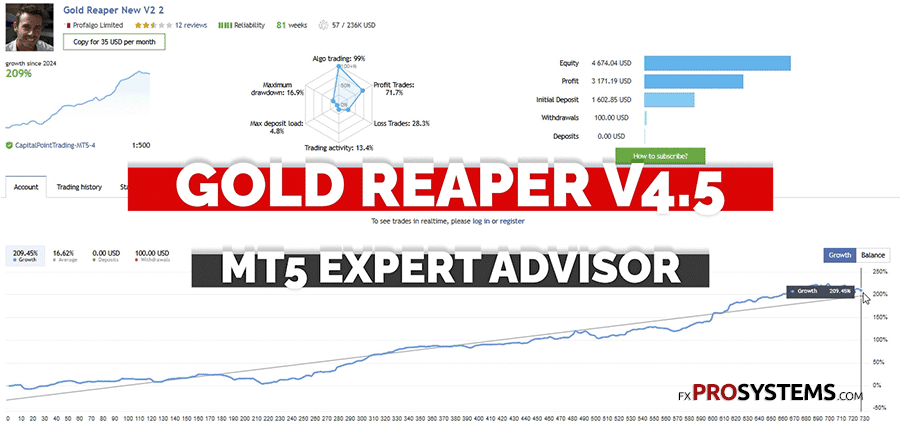
Quantum OmniGold EA - no grid, no martingale, but...
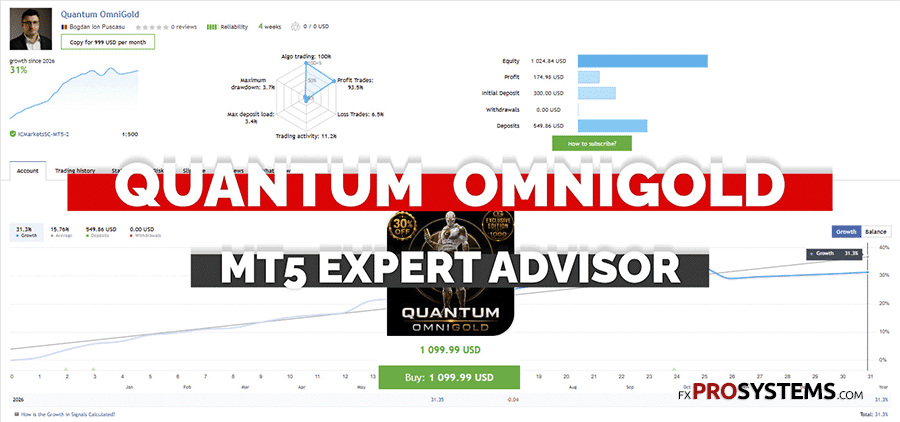
Quantum OmniGold is a new EA from the developer of Quantum Queen, which was described on the product page as the best-selling, highest-rated gold EA on MQL5. However, I should point out that it wiped out many of its users’ accounts and has now been removed from sale. Naturally, the developer needs a new product to replace it – after all, he can’t turn down such huge profits – and so, meet Quantum OmniGold. We’ll find out later just how many accounts this ‘miracle’ will wipe out? For now, it has 4 reviews, 10 activations, and a bold “only 1000 lifetime licenses available” banner. Price is $1,099.99, rising by $50 every 10 sales, up to $1,999.
This time the developer promises something new for the Quantum line: no grid, no martingale, every trade with its own stop loss, two take-profit levels, and a trailing stop. After Quantum Queen and Quantum Athena — both built on grid logic with no individual stops — that's a claim worth checking carefully. I ran the developer's own three test presets on RoboForex-ECN tick data, nominally covering 2018 through 2026. Here's what I found.



Key findings, up front
- The test period is declared as 2018.01.01–2026.07.03, but the first real trade in all three files is dated January 3, 2022
- From 2018 through the end of 2021, the EA opened zero positions — in any of the three tests
- No grid or martingale in the order log: 2,632 deals against 1,316 trades — exactly one entry and one exit per position
- The S/L field on every order reads 0.00 — protection works as a soft, EA-managed close rather than a real broker-side stop order
- Lot size grew roughly 30x over the test — from 0.01–0.02 to 0.57–0.58 on an auto-lot account
Characteristics of the Quantum OmniGold EA MT5 v1.8
- Official page: MQL5
- Platform: Metatrader5
- EA version: 1.8
- Currency pair: XAUUSD (Gold) only
- Trading hours: 24/5
- Timeframe: M15 (managed internally by the EA)
- Minimum deposit: $500 at 1:100 leverage; recommended $1,000+ at 1:500
- Account type: hedging
- Recommended brokers: Roboforex | XM | VT Markets - excellent for GOLD — ECN/RAW accounts
- VPS: required for continuous 24/5 operation
- Price: $1,099.99, rising $50 every 10 sales up to $1,999 and FREE here ↓
How does it work?
According to the developer, Quantum OmniGold makes decisions using a combination of ZigZag, a moving average, and stochastic, and — unlike this author's previous EAs — doesn't use grid or martingale. Each trade is supposedly independent, protected by a stop loss from the start, and managed with two take-profit levels plus an adaptive trailing stop.
The first thing I checked was whether that claim holds up in the actual order data. It does, literally: all three tests show exactly 2,632 deals against 1,316 trades — one entry and one exit per position, with no stacking in the same direction. Structurally, this is not a grid. Credit where it's due — on this point, the marketing matches what's in the log.
The “predefined stop loss” claim has a nuance the product page doesn't spell out, though. The S/L column on every order in the test report reads 0.00 — meaning this isn't a hard stop order sitting with the broker, it's logic inside the EA itself: it watches price and closes the position itself once it reaches the calculated level. In the trade comments this shows up as “sl 1817.51” rather than an actual broker-side stop firing. In practice the difference only matters in one scenario — if the connection to the terminal drops, the VPS goes down, or a price gap happens right at the moment a position should close on its stop. A real broker-side stop fires regardless. A software one only fires if the EA is there to see the price.
The second thing that stood out is the whole reason this article exists.
Testing
I ran three tests on RoboForex-ECN, tick data, 100% history quality, XAUUSD, M15, $1,000 deposit, 1:500 leverage — exactly as the developer set up in the preset files. The only difference between the tests is the auto-lot risk level: 3 (default), 5 (high), and 7 (extreme).
The first thing I did was open the order log and check what date the actual trades start. The report header states: “Period: M15 (2018.01.01 - 2026.07.03)” — eight and a half years, including the 2020 crash and the 2022 whipsaw. I ran the dates of every order through a simple year-by-year count. The result:
| Year | Number of trades (identical across all three tests) |
|---|---|
| 2018–2021 | 0 |
| 2022 | 1,746 |
| 2023 | 1,518 |
| 2024 | 1,704 |
| 2025 | 1,896 |
| 2026 (partial) | 1,032 – 1,062 |
Not a single trade in the first four years of the declared period. The first real order in all three files is January 3, 2022, at 03:27. This isn't a "bad" result for 2018–2021 — it's no result at all. The EA simply didn't operate for nearly four years out of the declared eight-year test.
I can't prove this from the outside, since I don't have the source code, but the pattern points more in one direction than the other. 2018 through 2021 was a genuinely rough stretch for a strategy like this one — a long, choppy gold consolidation with none of the sustained directional moves this EA seems to depend on, followed straight into the 2020 crash. A real data-quality problem would usually show up as gaps, missing ticks, or patchy execution scattered across the timeline — not a complete, four-year silence that switches on precisely at the start of 2022. That pattern looks less like "no signals found" and more like the developer already knows this EA doesn't hold up in that kind of market, and simply built the earliest tradeable date into the code so that period never shows up in a test. Either way, the difference matters a lot to a buyer: "tested on history since 2018" and "tested since early 2022" are two very different claims about reliability — and it's the first one that appears on the MQL5 page.
Test 1 — Default (risk profile 3) | $1,000 | 2018 (2022)-2026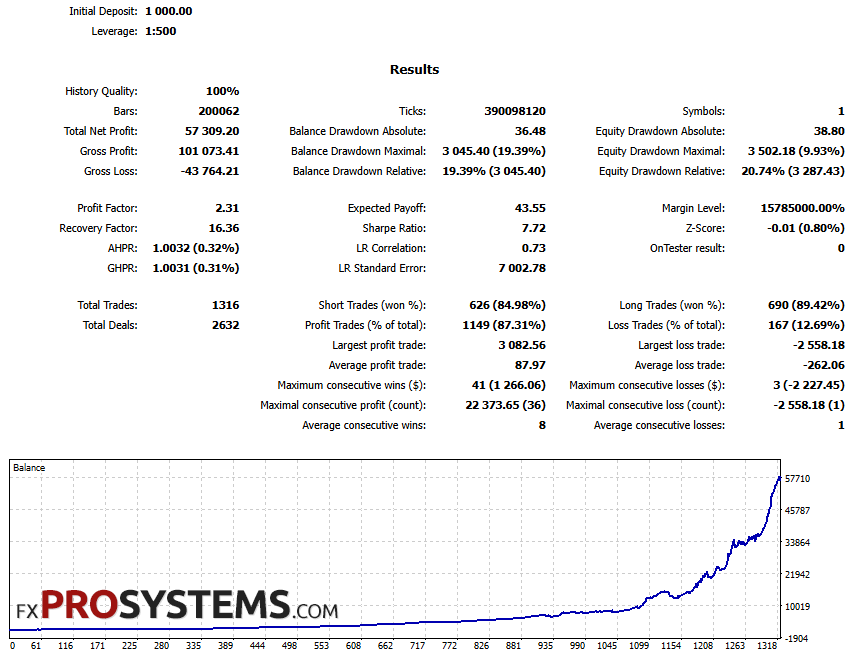
| Metric | Value | Metric | Value |
|---|---|---|---|
| Initial Deposit | $1,000 | Period | 2018–2026 (trades from 2022) |
| Total Net Profit | $57,309.20 | Total Trades | 1,316 |
| Profit Factor | 2.31 | Win Rate | 87.31% |
| Expected Payoff | $43.55 | Sharpe Ratio | 7.72 |
| Balance DD Max | 19.39% ($3,045.40) | Equity DD Max | 20.74% ($3,287.43) |
| Max Consec. Losses | 3 (-$2,227.45) | Recovery Factor | 16.36 |
| Largest Profit Trade | $3,082.56 | Largest Loss Trade | -$2,558.18 |
| Avg Profit Trade | $87.97 | Avg Loss Trade | -$262.06 |
✅ A profit factor above 2 and a drawdown around 19–20% over nearly 4.5 years is a decent result for gold — as long as you're not asking questions about the first four years of the declared range.
Test 2 — High-risk (risk profile 5) | $1,000 | 2018 (2022)-2026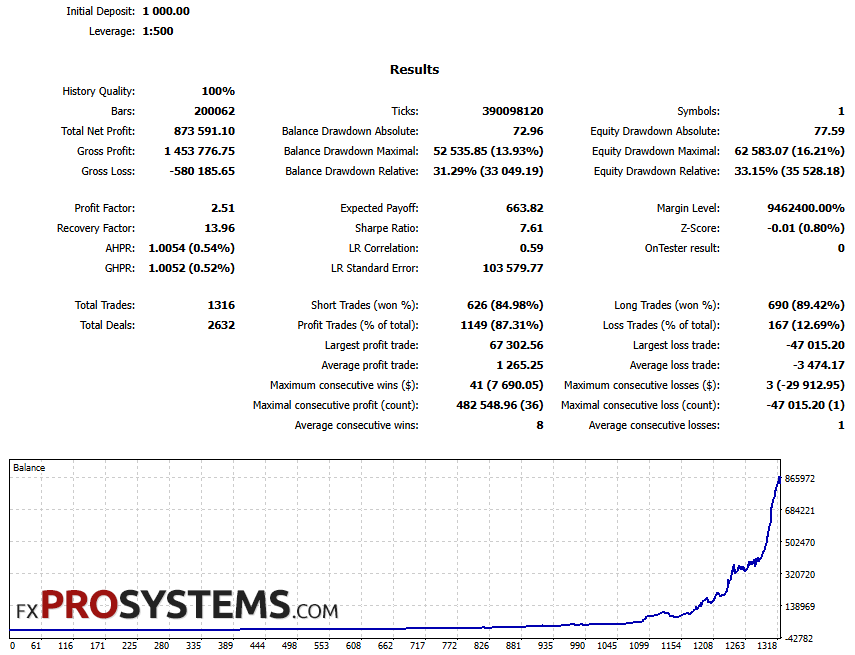
| Metric | Value | Metric | Value |
|---|---|---|---|
| Initial Deposit | $1,000 | Period | 2018–2026 (trades from 2022) |
| Total Net Profit | $873,591.10 | Total Trades | 1,316 |
| Profit Factor | 2.51 | Win Rate | 87.31% |
| Expected Payoff | $663.82 | Sharpe Ratio | 7.61 |
| Balance DD Max | 31.29% ($33,049.19) | Equity DD Max | 33.15% ($35,528.18) |
| Max Consec. Losses | 3 (-$29,912.95) | Recovery Factor | 13.96 |
| Largest Profit Trade | $67,302.56 | Largest Loss Trade | -$47,015.20 |
| Avg Profit Trade | $1,265.25 | Avg Loss Trade | -$3,474.17 |
The same 1,316 trades on the same dates — just with position size scaled up so balance drawdown grows from 19% to 31%. On paper, this profile turns $1,000 into almost $874,000 over 4.5 years. In reality, that growth would require a lot volume no broker would allow without margin, liquidity, and slippage requirements that look nothing like what the tester models.
Test 3 — Extreme-risk (risk profile 7) | $1,000 | 2018 (2022)-2026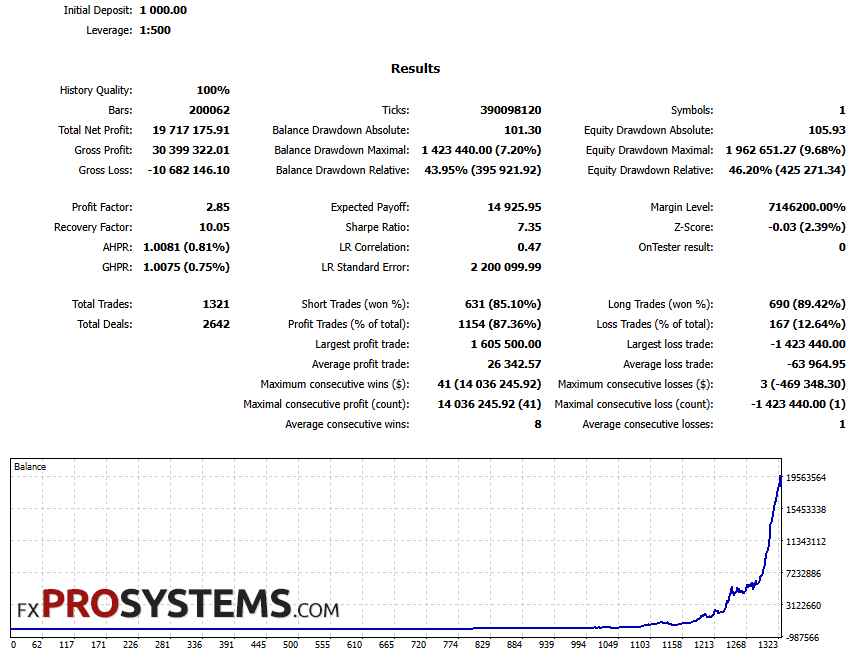
| Metric | Value | Metric | Value |
|---|---|---|---|
| Initial Deposit | $1,000 | Period | 2018–2026 (trades from 2022) |
| Total Net Profit | $19,717,175.91 | Total Trades | 1,321 |
| Profit Factor | 2.85 | Win Rate | 87.36% |
| Expected Payoff | $14,925.95 | Sharpe Ratio | 7.35 |
| Balance DD Max | 43.95% ($395,921.92) | Equity DD Max | 46.20% ($425,271.34) |
| Max Consec. Losses | 3 (-$469,348.30) | Recovery Factor | 10.05 |
| Largest Profit Trade | $1,605,500.00 | Largest Loss Trade | -$1,423,440.00 |
| Avg Profit Trade | $26,342.57 | Avg Loss Trade | -$63,964.95 |
❌ Almost $20 million out of a $1,000 starting deposit is a number worth stopping on. Not because it's impossible on paper with exponential auto-lot sizing, but because this is exactly the point where a backtest stops describing anything resembling real trading. At this profit level, position sizes by the end of the test run into the hundreds of standard lots on gold — margin requirements, market depth, and real slippage at that size would have nothing in common with what the MT5 tester shows. Extreme risk profile 7 exists in the EA's interface, but it doesn't exist as an executable scenario at any broker.
Summary across all three tests
| Risk profile | Deposit | Net profit | PF | Balance drawdown | Verdict |
|---|---|---|---|---|---|
| Default (3) | $1,000 | $57,309 | 2.31 | 19.39% | realistically profitable |
| High (5) | $1,000 | $873,591 | 2.51 | 31.29% | profitable, noticeably riskier |
| Extreme (7) | $1,000 | $19,717,176 | 2.85 | 43.95% | unrealistic in practice |
Worth keeping in mind about these numbers
- All three tests effectively cover the same window — January 2022 to July 2026, not the declared 2018–2026
- None of the tests show how the EA would have behaved during gold's 2018–2021 consolidation or the March 2020 crash — because it simply wasn't trading in those years
- The rising Profit Factor from 2.31 to 2.85 as risk increases is deceptive: it's not a “smarter” version of the strategy, it's the exact same set of trades with bigger bets attached
Quantum OmniGold EA Live signal | IC Markets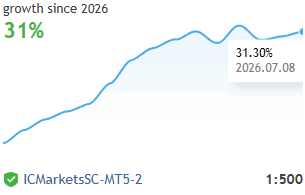
Input parameters of Quantum OmniGold EA
Settings in the test presets are grouped into a few categories.
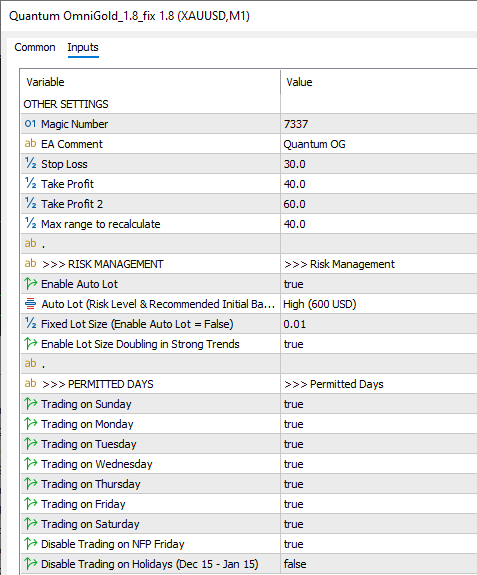
Risk and trade-management group
| Parameter | Purpose |
|---|---|
| InpSlUSD | Stop loss in dollars per trade (30.0 in the tests) |
| InpTpUSD | Base take profit in dollars (40.0) |
| InpTpHighATR | Extended take profit during high volatility (60.0) |
| MaxRangeToRecalculate | Range recalculation threshold (40.0) |
| Inp_auto_lot | Enables automatic lot sizing based on balance |
| Inp_risk_level_auto | Auto-lot risk level (3, 5, and 7 in the tests) |
| Inp_lot_size | Base lot size (0.01) |
| Inp_lot_doubling | Controls lot scaling — this is the parameter behind the 30x growth in position size over the test |
Allowed-days group
Day-of-week trading flags (Inp_TradeSunday…Inp_TradeSaturday), an NFP news filter (on by default), and a holiday filter (off by default).
The two that matter most here are Inp_risk_level_auto and Inp_lot_doubling. Their combination is what decides whether you end up with a 19% drawdown, as in the default test, or a 44% one, as in the extreme profile — on the exact same set of trades.
Conclusion
Quantum OmniGold isn't Quantum Athena, and it isn't Quantum Queen. The trade structure genuinely isn't a grid: one entry, one exit, no stacking in one direction. This is the rare case in this developer's lineup where the “no grid, no martingale” claim is confirmed by the order log rather than contradicted by it.
But the declared “full history 2018–2026” test turned out, on inspection, to be a test starting in January 2022 — nearly four years shorter than the report header and the sales-page framing suggest, where an eight-year test looks far more solid than a four-year one. I don't know whether this was a deliberate choice by the developer or a technical data limitation, but the outcome for a buyer is the same either way: what looks like a test that survived the COVID crash and the 2022 volatility actually starts after both of those events.
Would I trade this on a live account? With the default risk profile (3) and a modest deposit — possibly, following the recommendations below. With the extreme profile (7) — no, not a chance: that $19.7 million figure is a backtest artifact, not something to plan around. The product is six days old, has 10 activations and 4 reviews — there isn't yet a live trading track record to back these numbers up in practice.
My safety checklist
- Start on a demo account only — at least a few months of observation before moving to real money
- Don't use a risk profile above “default” (3) — profiles 5 and 7 exist in the interface but not in executable reality
- Withdraw profits regularly — don't let auto-lot compound indefinitely
- Use a reliable VPS — the software stop loss only protects while the EA can see the price
- Choose an ECN/RAW account with tight gold spreads — Roboforex or IC Markets
- Before trusting an eight-year test on a product page, check the date of the first trade in the log — as this case shows, the declared period and the actual one can differ
For stable automated trading, I would recommend taking a look at the Gold Bundle
In the archive Quantum_OmniGold_EA.rar (156.3 Kb):
- Quantum OmniGold_1.8_fix.ex5
Free Download Quantum OmniGold EA MT5 v1.8