Quantum Athena MT5 EA - beautiful charts, but the full history tells a different story

Quantum Athena is a brand-new Gold EA from Bogdan Ion Puscasu — the developer behind Quantum Queen, the highest-rated EA on MQL5. It appeared on the marketplace on April 21, 2026, as the "lighter, more affordable" sibling of Quantum Queen. The marketing is polished, the developer’s track record is undeniable, and the price tag of $1099.99 is steep enough that you’d expect something rock-solid inside.
I decided to run my own tests from 2018 — going back further than the developer’s showcased results. What I found was a clear pattern of cherry-picking: when you start the test from 2022, things look spectacular. When you start from 2018 with default settings, the account blows up. That’s not a minor detail — it’s the whole story. Let me show you exactly what I found.



- This EA is a grid system with no individual stop losses on trades
- Default settings blow the account in the 2018–2026 full-period backtest
- Cherry-picking detected: developer’s presented results appear to start from 2022
- Published only on April 21, 2026 — no meaningful live signal history
Сharacteristics of the Quantum Athena EA MT5 v1.1
- Official website: MQL5
- Platform: Metatrader5
- EA version: 1.1
- Currency pairs: XAUUSD (Gold) only
- Trading Time: 24/5 (around the clock on weekdays)
- Timeframe: M15 chart (EA manages internally)
- Minimum deposit: $500 at 1:500 leverage; recommended $1000 or 1000 USD cents, best conditions here ➔ ProCent
- Recommended broker: Roboforex | VT Markets - excellent for GOLD | XM — ECN/RAW only. 2-decimal GOLD quote. 3-decimal brokers: NOT compatible
- Price: $1,099.99 — more than the recommended deposit and FREE here ↓
How does it work?
Quantum Athena is explicitly a grid EA. The developer confirms this openly — and that’s one of the few things I appreciate about the product page: there’s no attempt to hide the grid architecture behind buzzwords. The EA opens an initial Gold position, and if the price moves against it, additional positions are opened at calculated intervals. When the whole basket of positions reaches a combined profit target, everything closes together.
From the order history in my tests, you can see the pattern clearly: SL = 0.00 on every single trade. There are no individual stop losses. The EA manages risk at the basket level, not the trade level. During adverse conditions, the floating loss can grow substantially before the market reverses.
The key features claimed by the developer:
- Focuses exclusively on XAUUSD — no multi-pair dilution
- Multiple entries per grid sequence (labels show T1/S01 through T3/S06 levels)
- Built-in drawdown mode (InpDDMode parameter) to halt trading at a set DD threshold
- Spread and slippage filters (InpSpread=30, InpSlippage=30 in tests)
- Holiday filter (InpXmas parameter)
- Visual panel on chart for monitoring open positions
- Three lot calculation modes: fixed lot, auto lots by balance, fixed lot per balance
What the marketing doesn’t tell you plainly: this is a buy-side averaging-down grid. The EA opens mostly long (buy) positions — 87.6% long vs 12.4% short in my 2018–2026 tests. Gold has trended up since 2018, which explains why a buy-heavy grid can look decent over certain periods. But averaging down into a sustained drop is a high-risk strategy that depends on mean-reversion materializing before the margin runs out.
Testing Results
I ran 8 backtests on RoboForex-ECN, all on XAUUSD M15 with 100% history quality. Spread=30, slippage=30 (realistic ECN conditions). Here is what I found.
❌ CHERRY-PICKING DETECTED
- Tests from 2022–2026 (default settings): Profit Factor 6.65–6.67, stunning equity curves
- Tests from 2018–2026 (same default settings): Account BLOWN, Profit Factor 0.89–0.92
- This is not a coincidence. The 2018–2021 period was clearly unfavorable for this strategy
- If the developer’s marketing shows only 2022+ results, that is deliberate omission of a blow-up
Test 1 — 2018–2026 | $1,000 | Default Settings (InpLotsCalc=0, fixed 0.01 lot)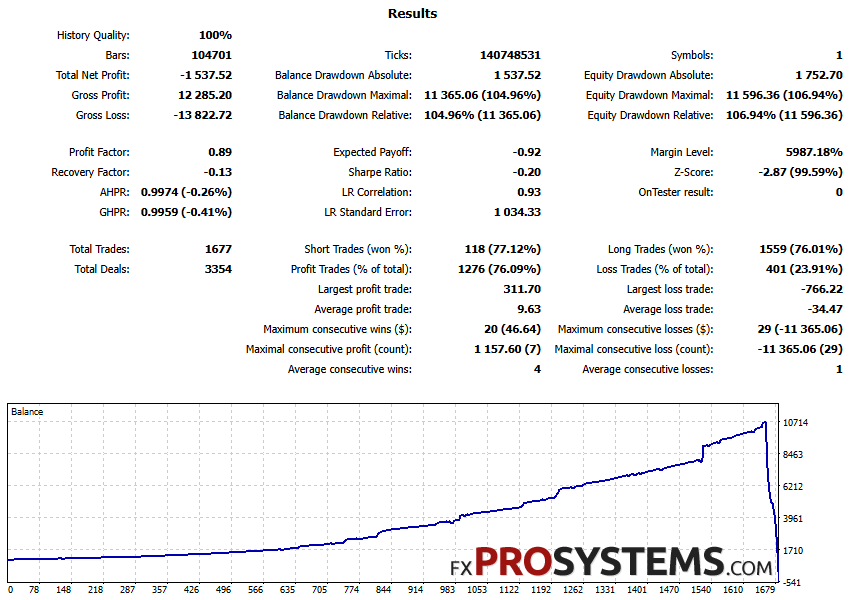
This is the most honest test: the same period and settings any new user would likely run. The result is a blown account.
| Metric | Value | Metric | Value |
|---|---|---|---|
| Initial Deposit | $1,000 | Period | Jan 2018 – May 2026 |
| Total Net Profit | -$1,537.52 | Total Trades | 1,677 |
| Profit Factor | 0.89 | Win Rate | 76.09% |
| Expected Payoff | -0.92 | Sharpe Ratio | -0.20 |
| Balance DD Max | 104.96% ($11,365) | Equity DD Max | 106.94% ($11,596) |
| Max Consec. Losses | 29 (-$11,365!) | Recovery Factor | -0.13 |
| Largest Profit Trade | $311.70 | Largest Loss Trade | -$766.22 |
| Avg Profit Trade | $9.63 | Avg Loss Trade | -$34.47 |
❌ RESULT: ACCOUNT BLOWN
- Profit Factor 0.89 — a losing strategy over the full test period
- 29 consecutive losses totaling -$11,365 on a $1,000 account — grid confirmed
- Balance drawdown exceeded 104% — the account is wiped
Tests 2, 3, 4 — 2018–2026 | $1,000 | Auto Lots (Low / Medium / High Risk):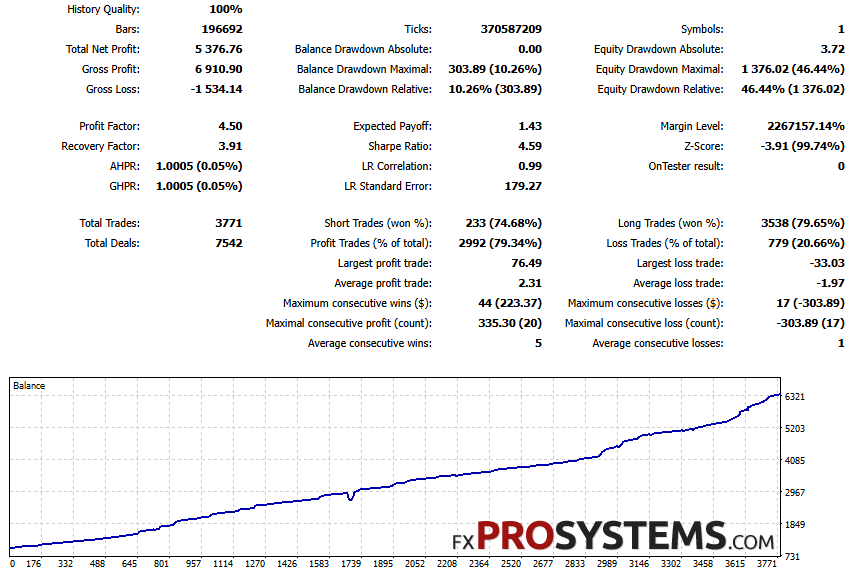
I ran three separate tests with InpLotsCalc=1 (auto lots by balance) at different risk levels: AutoLotsValue=1 (Low), =3 (Medium), =5 (High). All three produced — word for word — identical results (only one test is shown here, the others are identical to this one). This is because at a $1,000 balance on XAUUSD, the auto-lot calculation rounds down to the minimum 0.01 lot regardless of the risk setting. In practice, the risk levels only differentiate at higher balances.
| Metric | Value | Metric | Value |
|---|---|---|---|
| Initial Deposit | $1,000 | Period | Jan 2018 – May 2026 |
| Total Net Profit | +$5,376.76 | Total Trades | 3,771 |
| Profit Factor | 4.50 | Win Rate | 79.34% |
| Expected Payoff | 1.43 | Sharpe Ratio | 4.59 |
| Balance DD Max | 10.26% ($304) | Equity DD Max | 46.44% ($1,376) |
| Max Consec. Losses | 17 (-$303.89) | Recovery Factor | 3.91 |
These numbers look good on paper, but there is an important nuance. With auto lots mode and $1,000, you’re still trading 0.01 lots — same as fixed lot mode. The equity drawdown reaching 46.44% is worth noting: that means your floating losses at one point were nearly half your account, even with micro-lots. Scale up to 0.1 or 1.0 lots and those same drawdown moments become catastrophic.
Test 5 — 2018–2026 | $1,000 | Fixed Lot per Balance (InpLotsCalc=2, $1,000 per lot)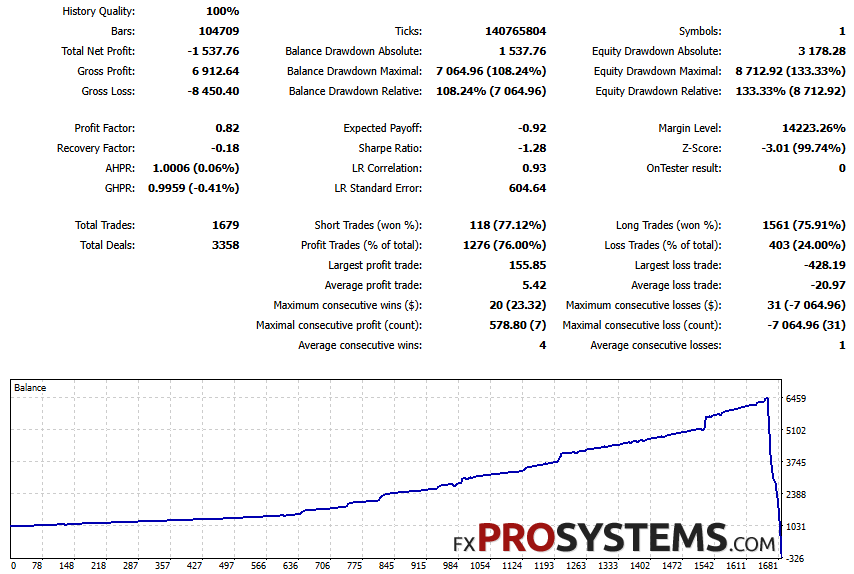
This mode scales lot size proportionally to balance. With $1,000 and InpLotsFixedBalance=1,000, the EA starts at 0.01 lots and compounds. The result: another blown account.
| Metric | Value | Metric | Value |
|---|---|---|---|
| Initial Deposit | $1,000 | Period | Jan 2018 – May 2026 |
| Total Net Profit | -$1,537.76 | Total Trades | 1,679 |
| Profit Factor | 0.82 | Win Rate | 76.00% |
| Expected Payoff | -0.92 | Sharpe Ratio | -1.28 |
| Balance DD Max | 108.24% ($7,065) | Equity DD Max | 133.33% ($8,713) |
| Max Consec. Losses | 31 (-$7,065) | Recovery Factor | -0.18 |
❌ RESULT: ACCOUNT BLOWN
- Equity drawdown hit 133.33% — account destroyed and then some
- 31 consecutive losses in one sequence — this is what a grid blow-up looks like
Test 6 — 2018–2026 | $100,000 | Default Settings (Scaled lots ~1.25)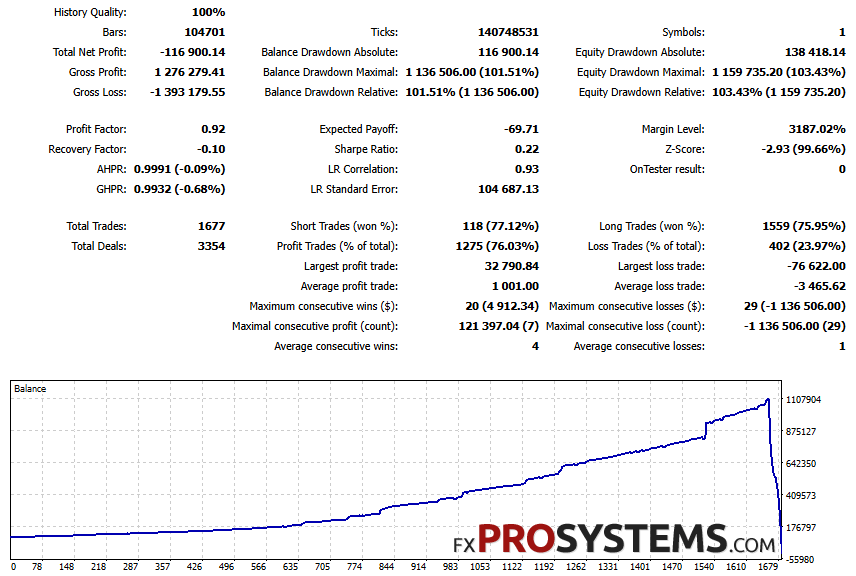
I tested with a $100,000 deposit to see how the default auto-scaling behaves at larger size. The EA opened positions at ~1.25 lots. Same story, just much larger dollar amounts.
| Metric | Value | Metric | Value |
|---|---|---|---|
| Initial Deposit | $100,000 | Period | Jan 2018 – May 2026 |
| Total Net Profit | -$116,900 | Total Trades | 1,677 |
| Profit Factor | 0.92 | Win Rate | 76.03% |
| Expected Payoff | -$69.71 | Sharpe Ratio | 0.22 |
| Balance DD Max | 101.51% ($1.13M!) | Equity DD Max | 103.43% |
| Largest Loss Trade | -$76,622< | Max Consec. Losses | 29 (-$1.14M) |
❌ RESULT: ACCOUNT BLOWN (both $1,000 and $100,000 deposits)
- A single sequential loss run wiped $1,136,506 from a $100,000 account
- This confirms the blow-up is structural, not a deposit-size artifact
Tests 7 — 2022–2026 | $500 | Default Settings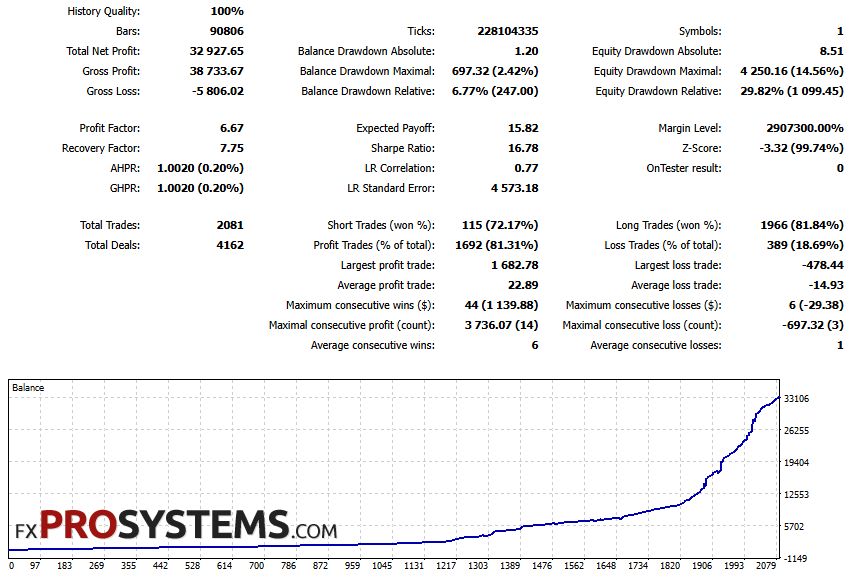
Tests 8 — 2022–2026 | $1000 | Default Settings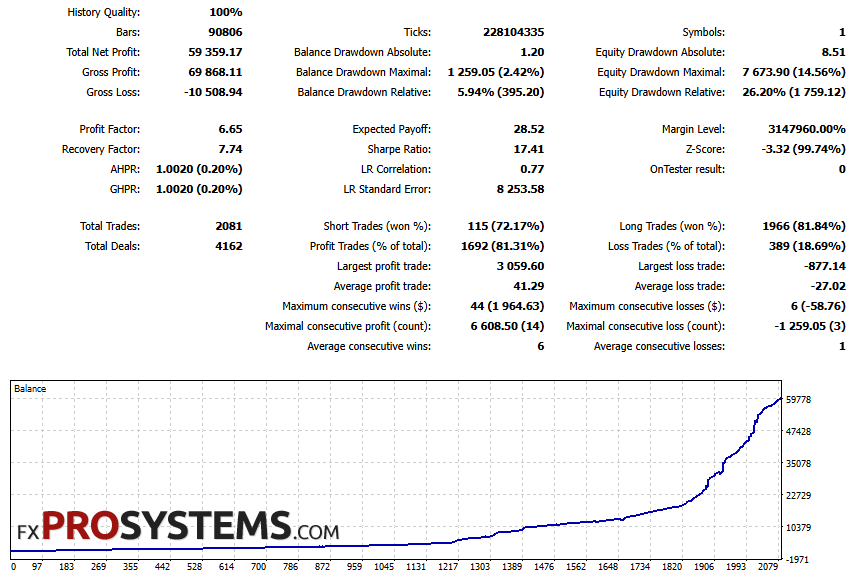
Starting from July 2022 — after Gold’s major consolidation and the beginning of the strong bull trend — the picture looks completely different. This is almost certainly the period the developer highlights in the MQL5 product screenshots.
| Metric | Value | Metric | Value |
|---|---|---|---|
| Initial Deposit | $500 / $1,000 | Period | Jul 2022 – May 2026 |
| Total Net Profit | +$32,927 / +$59,359 | Total Trades | 2,081 |
| Profit Factor | 6.67 / 6.65 | Win Rate | 81.31% |
| Expected Payoff | 15.82 / 28.52 | Sharpe Ratio | 16.78 / 17.41 |
| Balance DD Max | 2.42% | Equity DD Max | 14.56% |
| Max Consec. Losses | 6 (-$29 / -$59) | Recovery Factor | 7.75 / 7.74 |
✅ 2022–2026 results are genuinely impressive
✅ Profit Factor 6.65–6.67 is excellent
✅ Balance drawdown under 3% is very low
✅ But: this is the favorable window — the 2018–2022 blow-up history is hidden
All Tests — Summary Comparison
| Period | Deposit | Net Profit | PF | DD Bal% | DD Eq% | Max Loss | Result |
|---|---|---|---|---|---|---|---|
| 2018-2026 (Blow) | $1,000 | -$1,537.52 | 0.89 | 104.96% | 106.94% | 29 | red |
| 2018-2026 (Fixed/Auto Low) | $1,000 | +$5,376.76 | 4.50 | 10.26% | 46.44% | 17 | orange |
| 2018-2026 (Fixed/Auto Med) | $1,000 | +$5,376.76 | 4.50 | 10.26% | 46.44% | 17 | orange |
| 2018-2026 (Fixed/Auto High) | $1,000 | +$5,376.76 | 4.50 | 10.26% | 46.44% | 17 | orange |
| 2018-2026 (Per Bal Med) | $1,000 | -$1,537.76 | 0.82 | 108.24% | 133.33% | 31 | red |
| 2018-2026 (Blow $100k) | $100,000 | -$116,900 | 0.92 | 101.51% | 103.43% | 29 | red |
| 2022-2026 (Default) | $500 | +$32,927 | 6.67 | 2.42% | 14.56% | 6 | green |
| 2022-2026 (Default) | $1,000 | +$59,359 | 6.65 | 2.42% | 14.56% | 6 | green |
The pattern is crystal clear. With default settings, the 2018-2026 tests blow the account. The 2022-2026 tests are excellent. The auto-lots tests (tests 2-4) show positive results for the full period, but only because all three risk levels collapse to the same minimum 0.01 lot at $1,000 — effectively a fixed-lot test in disguise.
Quantum Athena EA Live signal | IC Markets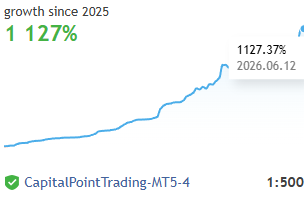
Quantum Athena EA Live signal | VT Markets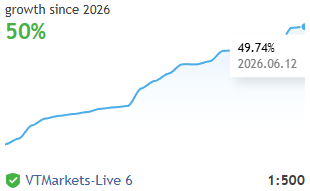
Input Parameters
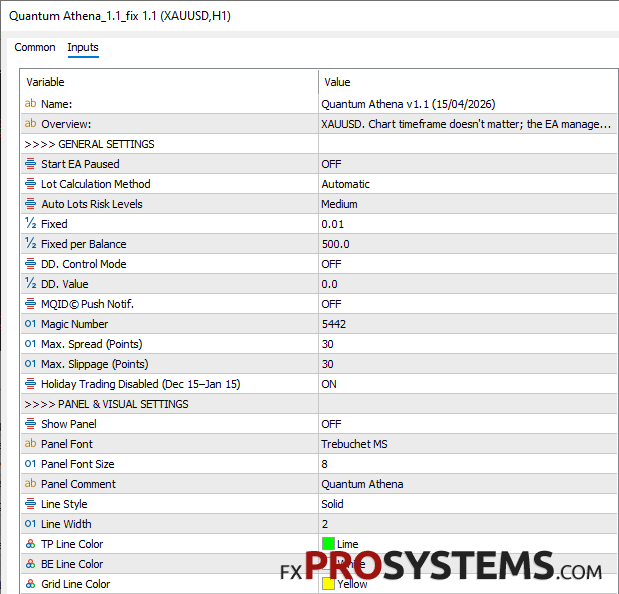
Important: 2-decimal price quotes for GOLD. Quantum Athena is not compatible with brokers that offer 3-decimal price quotes for GOLD
The EA parameters are organized into two groups:
Group #1 — Risk and Trade Management
| InpPause | Trade pause on/off — useful for manual intervention |
| InpLotsCalc | Lot calculation mode: 0=default scaling, 1=auto lots by balance, 2=fixed per balance |
| InpAutoLotsValue | Risk level for auto lots (1=Low, 3=Medium, 5=High) — only effective at larger deposits |
| InpLotsFixed | Fixed lot size (default 0.01) |
| InpLotsFixedBalance | Balance per 0.01 lot for mode 2 (default $500) |
| InpDDMode | Drawdown protection mode — set this to limit catastrophic loss |
| InpDDValue | Drawdown threshold value for DD mode |
| InpSpread | Maximum allowed spread (default 30) — do not lower this below your broker’s spread |
| InpSlippage | Maximum allowed slippage (default 30) |
| InpXmas | Holiday filter on/off |
| InpMagicNumber | EA identifier (default 5442) |
Group #2 — Display Settings
These control the visual panel on chart: font, colors for TP/BE lines, grid colors. Not relevant to trading performance.
The most important parameter for risk control is InpDDMode. I strongly recommend activating it with a maximum drawdown of 20-30% if you choose to run this EA. Without it, the EA will keep adding positions into a losing sequence without any circuit breaker.
Conclusion
Bogdan Ion Puscasu may be an experienced and trustworthy developer, but is he simply a seller of digital junk? His track record — over 1,600 combined verified reviews across the Quantum series — is real. But that reputation doesn’t make Quantum Athena a safe EA for your live account today.
Here is my honest assessment after running all 8 tests. The EA is a Gold grid with no individual stop losses. In the 2022-2026 period, it performed exceptionally well: Profit Factor above 6.6, balance drawdown under 3%, win rate above 80%. That is genuinely impressive. But when I tested the same default settings from 2018, the account blew up every time. The 2018-2022 period — which includes Gold’s post-2020 volatility and the 2022 correction — was clearly hostile to this strategy.
The developer’s product screenshots and marketing almost certainly feature only the 2022+ window. This is cherry-picking, and it is a red flag I cannot ignore. On MQL5, there are no live signals linked to Athena yet. The EA has 187 demo downloads and zero reviews as of May 2026. You’d be buying a very new, unproven product on the basis of a selectively presented backtest.
If you want a Gold grid EA from this developer with actual live track record, look at Quantum Queen. It has 20+ months of verified live signals. Athena does not. The lower price ($1099.99 vs $1999+) makes sense given the lack of live history.
My Safety Checklist
- Always start on a demo account — minimum 3 months before going live
- Use a $1,000+ deposit with 0.01 fixed lot — do not scale up until you see how it performs
- Always activate InpDDMode with a 20-25% drawdown limit as your circuit breaker
- Use an ECN broker with tight Gold spreads — I tested on RoboForex-ECN, Roboforex is a solid choice
- Run on a dedicated VPS — connection drops during an open grid can be expensive
- Withdraw profits regularly — never let the EA compound beyond your personal risk tolerance
- Watch the equity curve, not just the balance — that’s where the real risk hides in a grid EA
For stable automated trading, I would recommend taking a look at the Gold Bundle
In the archive Quantum_Athena_MT5.rar (514 Kb):
- Quantum Athena_1.1_fix.ex5
Free Download Quantum Athena MT5 v1.1
Free Download Quantum Athena EA MT5 v1.1