Quantum Titan EA — the “no grid, no martingale” Quantum, and what its own signal page won't add up to
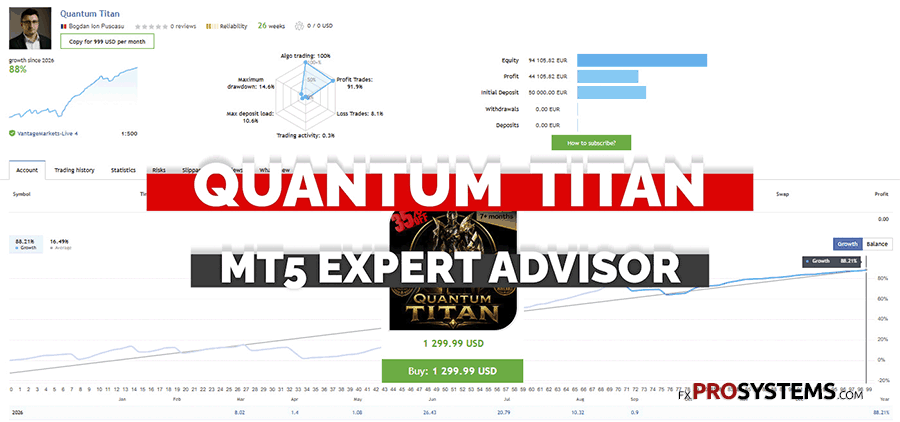
Same developer, same “Quantum” ecosystem, this time a genuinely different pitch. Where Quantum Queen X leans into its grid-and-cycle identity, Quantum Titan's entire marketing case rests on the opposite claim: no grid, no Martingale in the default configuration, a predefined Stop Loss on every trade, and a “selective” approach that would rather sit out a session than force a trade. Published 7 August 2026, capped at 1,000 lifetime licenses, already at 174 purchases a month with a 4.81 rating from 25 reviews. I read the product page closely, went through the reviews and comments, dug up independent structural audits of Quantum Titan EA from outside the vendor's own material, ran seven backtests across its risk presets and settings, and picked apart the live signal's own numbers. One thing in that signal's history doesn't add up, and it's not a subtle one.
Characteristics of the Quantum Titan EA MT5 v2.2
- Official page: MQL5
- Platform: Metatrader5
- EA version: 2.2
- Currency pair: XAUUSD (Gold) only
- Trading hours: 24/5
- Timeframe: Not tied to a specific chart timeframe — the developer doesn't specify one; only used M15 for testing purposes
- Minimum deposit: $500 official minimum, $1,000 recommended (tests used $1,000)
- Account type: hedging
- Recommended brokers: Roboforex | XM | VT Markets - excellent for GOLD — ECN/RAW accounts
- VPS: required for continuous 24/5 operation
- Price: $1,299.99 (rises $50 every 10 purchases, final price $1,999) and FREE here ↓
How does it work?
The pitch here is a deliberate contrast with the rest of the Quantum lineup. The product page states plainly that Quantum Titan does not use a Grid strategy, and does not use Martingale in its recommended default configuration — note the qualifier, which leaves the door open for non-default configurations to behave differently, though nothing in the public material specifies what those would be. Every position is supposed to be protected by a Stop Loss from the moment it opens, managed individually, with a dynamic trailing stop to lock in gains as a trade develops.



The other half of the pitch is patience: Titan is described as “selective by design,” waiting for qualified setups rather than trading continuously, with some days producing no trades at all. The backstory the developer tells is that Titan was traded privately on his own €50,000 live account for months before this public release — the largest initial capital commitment the developer says he's made to any Quantum product.
What a structural audit found
I put this EA through an independent structural audit, separate from anything the vendor's own materials claim. Here's what came out of it:
- Risk profile: stop discipline observed on individual trades; largest measured drawdown −14.6%
- Of this seller's 12 recorded products, 4 are no longer available — no reason given, could be discontinuation or replacement (the same pattern I've been tracking with Quantum Queen specifically)
- Data quality concern: the EA takes no trades for the first 16.7 years of the nominal 2003–2026 test window — real activity effectively starts 2020.01.02
- Concentration concern: 80% of total profit came from just 55 of 1,256 active trading days (4.4%) — 0.9% of the full 23.3-year window
- Structure: up to 2 positions open at the same time — position-stacking, nothing close to a full grid basket
- 48 drawdown episodes recorded; the longest kept the account underwater for 709 trading days — close to 3 years
- Cost fragility: an extra $0.56 per trade in spread/slippage/commission is enough to erase the entire edge
- Withdrawal replay: only 35 of 80 simulated months paid out anything; longest dry streak 30 months
- Prop-firm rule replay: 0 account deaths at base sizing against The5ers, FTMO, and a generic 6% trailing profile
Two of these are worth sitting with. First, the profit concentration: 80% of everything this strategy has ever made came from 4.4% of its active trading days. That's not necessarily a defect — some legitimate strategies are inherently lumpy, catching a handful of big trend moves a year — but it does mean the smooth-looking equity curve on the product page is doing a lot of work to hide how binary the actual outcome depends on a small number of days going right.
Second, the cost fragility figure. Fifty-six cents per trade sounds trivial until it's connected to what a real user reported in the reviews: identical trades producing profit on some brokers and losses on others, because of spread and slippage differences alone.
What real users are reporting
Reviews for a three-week-old product skew heavily toward the honeymoon period, and most of the 25 here read that way — first-week profits, enthusiastic five-star ratings, warm exchanges with a famously responsive developer. One review stood out for going into real detail. A user called Skif tested Titan across three terminals, including an FTMO demo account, for close to two weeks. The same trades that were profitable on Roboforex and IC Markets sometimes lost money on FTMO, and where FTMO trades were profitable, the gains were often two to three times smaller than on the other two brokers. Skif's conclusion: fine for a personal live account with genuinely low spreads, but not something to run specifically for prop-firm evaluation, partly because near-identical trades across many users on the same broker could also draw unwanted attention from a prop firm's rule engine.
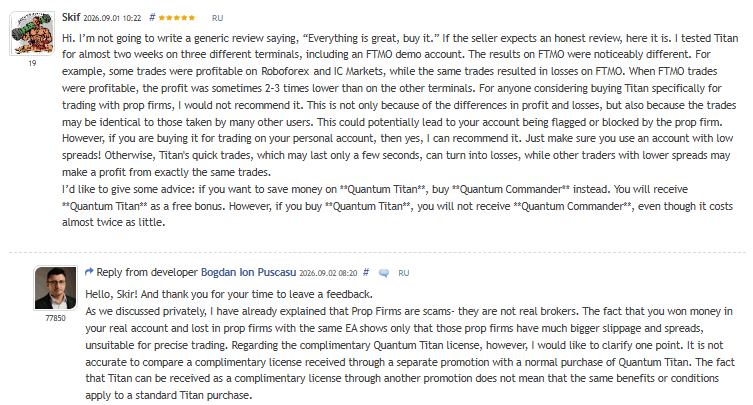
The developer's reply to this review is worth noting for its framing rather than its content: he characterized prop firms generally as “scams” and attributed the discrepancy entirely to their execution quality — not entirely unreasonable given the cost-fragility finding above, but also a response that sidesteps the part of the review warning other users away from a specific use case.
One more detail buried in a longer review from a user called bWise: Titan is described as running the “same baseline” as another of the developer's products, Quantum OmniGold, but more refined. That's a useful data point for anyone comparing products in this lineup — Titan doesn't appear to be an entirely new codebase so much as a refinement of an existing one.
Testing
I ran five backtests: RoboForex-ECN, XAUUSD, M15, 2018.01.01–2026.08.31, $1,000 starting deposit, 100% history quality — covering Fixed lot, Balance-scaled, Default (Auto risk level 3 of 8), Percent risk (5%), and Extreme (risk level 7 of 8).
XAUUSD M15 | 2018 – 2026 | $1,000 | Fixed lot 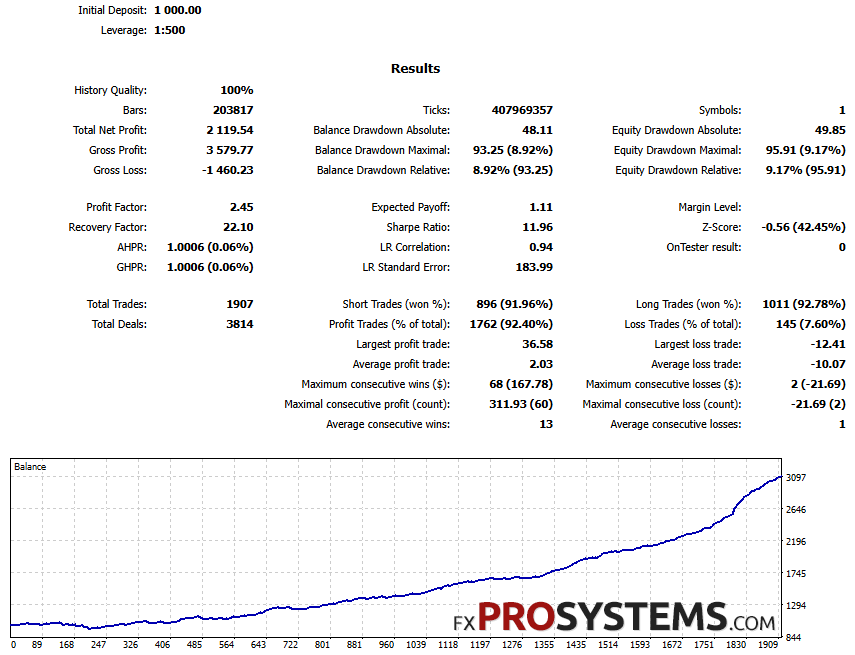
XAUUSD M15 | 2018 – 2026 | $1,000 | Balance-scaled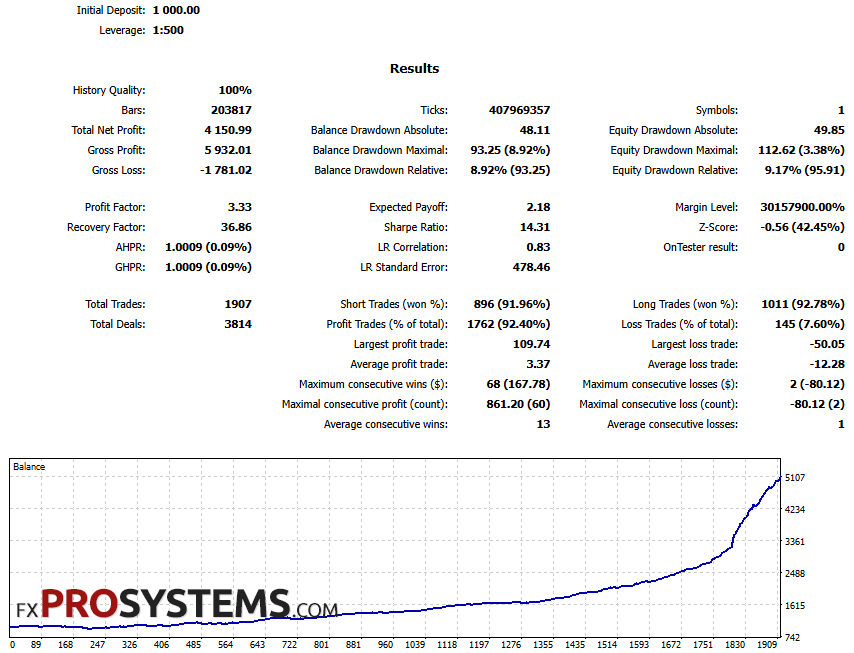
XAUUSD M15 | 2018 – 2026 | $1,000 | Default (Auto risk)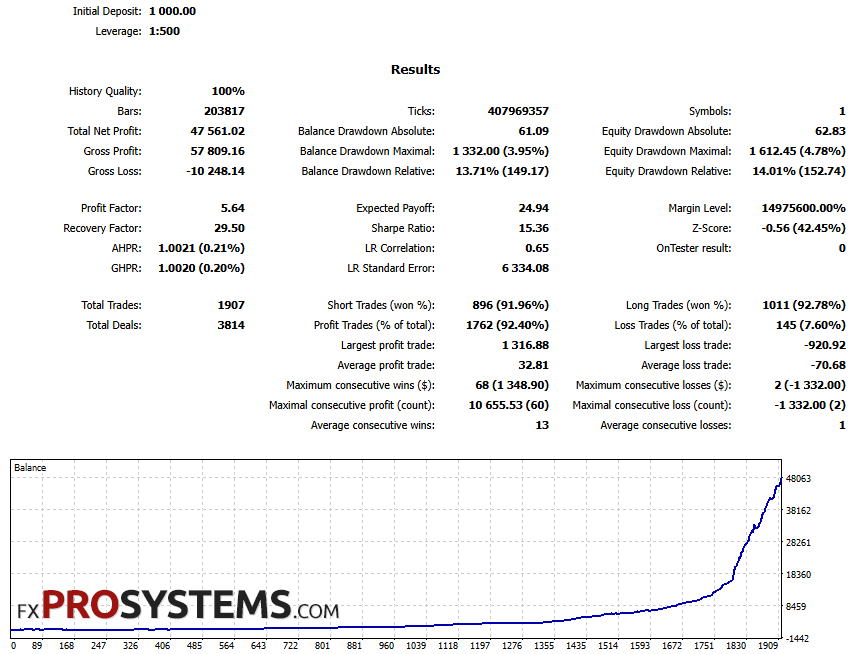
XAUUSD M15 | 2018 – 2026 | $1,000 | Percent risk (5%)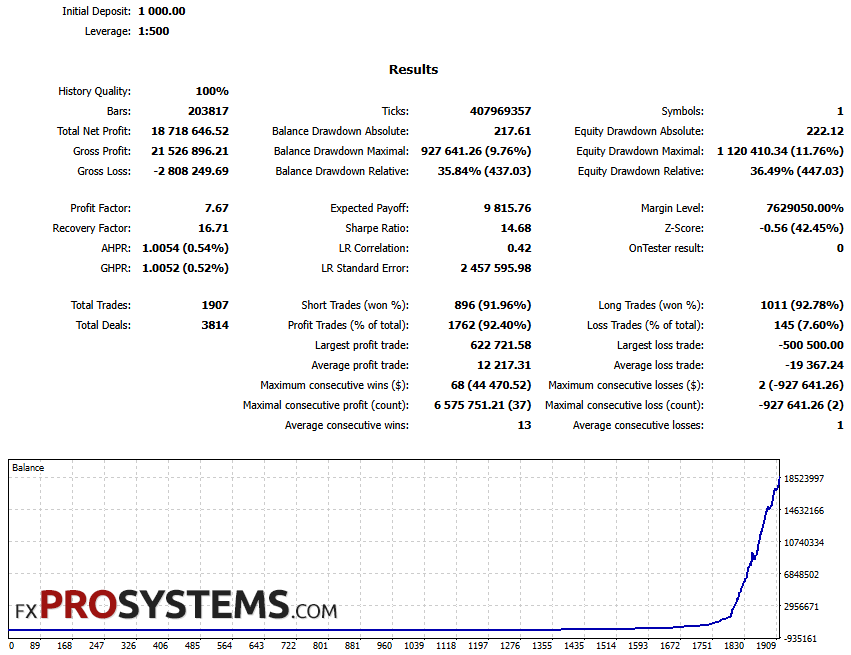
XAUUSD M15 | 2018 – 2026 | $1,000 | Extreme risk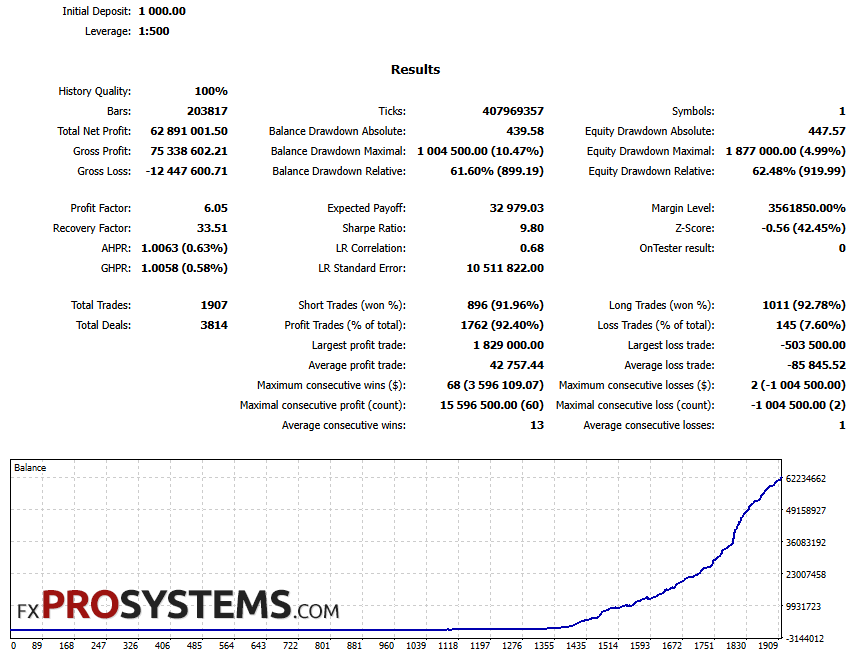
| Preset | Net profit | Profit Factor | Balance DD (relative) | Equity DD (relative) | Sharpe |
|---|---|---|---|---|---|
| Fixed lot (0.01) | $2,119.54 | 2.45 | 8.92% | 9.17% | 11.96 |
| Balance-scaled (0.01/$1,000) | $4,150.99 | 3.33 | 8.92% | 9.17% | 14.31 |
| Default (Auto risk 3/8) | $47,561.02 | 5.64 | 13.71% | 14.01% | 15.36 |
| Percent risk (5%) | $18,718,646.52* | 7.67 | 35.84% | 36.49% | 14.68 |
| Extreme (Auto risk 7/8) | $62,891,001.50* | 6.05 | 61.60% | 62.48% | 9.80 |
* Net profit at the higher risk presets is inflated by auto-lot compounding on a growing balance — the same pattern flagged in the Quantum King and Quantum Queen X reviews — and isn't a realistic withdrawal figure.
A few things stand out, some genuinely reassuring, some not.
The good news first, and it's real. Every single one of the 1,907 trades across all five backtests closed the same way: tagged “sl” in the deal comment. Not a basket close, not a cycle exit — an individual stop-loss level on every single trade, exactly as advertised. Trade count (1,907), win rate (92.40%), and Z-Score (-0.56) are identical across all five presets — only position sizing changes between them, never the underlying signals. That's structurally consistent with “no grid”: this EA picks the same trades regardless of risk setting and just sizes them differently, rather than opening more trades or building baskets at higher risk. Deal dates checked year by year show trading is genuinely continuous from January 2018 through August 2026 — no multi-year silent gap like the one found in Quantum Queen X's history.
Now the parts worth slowing down for.
MaxDrawdownPercent=0.0 in all five tests. This is the account-level drawdown protection input, and it's disabled by default across every single preset tested, including Default. That makes Quantum Titan the third product in a row from this developer — after Quantum King and Quantum Queen X — where the account-wide drawdown floor ships switched off. The per-trade Stop Loss is real and does its job on individual trades, but nothing stops the account itself from compounding a bad stretch.
UseRecoveryMode=false, but RecoveryMultiplier=2.0 exists in the settings. This directly explains the careful wording on the product page — “no Martingale in its recommended default configuration.” The recovery/multiplier logic is built into the EA; it's just switched off in every one of these five presets, including Extreme. Two follow-up tests checked what happens when it's switched on and when the drawdown floor is tightened — see below.
Profit is heavily concentrated in the most recent stretch of the test. The Default preset's realized profit broken down year by year: 2026 alone (through August) accounts for $32,735 of the $47,561 total — 68.8% of everything the strategy has made across 8.5 years, in its final 8 months. 2025 and 2026 combined account for 87.6% of total profit. This isn't a vague impression — it's a direct, quantified confirmation of the concentration issue. Whatever regime gold has been in for the last year and a half, a large share of this strategy's entire track record depends on it.
Balance DD Relative scales steeply and non-linearly with risk. 8.92% → 13.71% → 35.84% → 61.60% moving from Fixed lot through to Extreme. Profit factor barely moves in the same range (2.45 to 7.67) — the extra risk at the top end isn't being compensated proportionally.
The first five backtests ran on Roboforex; the product page recommends VT Markets and other. Given the cost-fragility finding above account of meaningfully different results across brokers, a broker-matched test was one of the more important gaps left — closed in the follow-up round below.
Follow-up tests — a tighter drawdown floor, and Recovery Mode confirmed
Two more backtests, this time on VT Markets, $1,000 deposit — matching the deposit used in the five tests above — same Default risk level (3/8), 100% history quality, changing exactly one setting each time from the same baseline: one with MaxDrawdownPercent tightened to 1.5%, one with Recovery Mode switched on and no drawdown floor.
A scope note: these two runs cover a shorter window than the rest of this article — 2026.01.01 to 2026.09.01, about 8 months, rather than the full 2018–2026 period used everywhere else. That's a much smaller sample (135–138 trades instead of 1,907), so treat the specific numbers below as a narrower, more recent snapshot rather than a full-history result on the same footing as the five backtests above.
VT Markets | XAUUSD M15 | 2018 – 2026 | $10,000 | MaxDrawdownPercent = 3%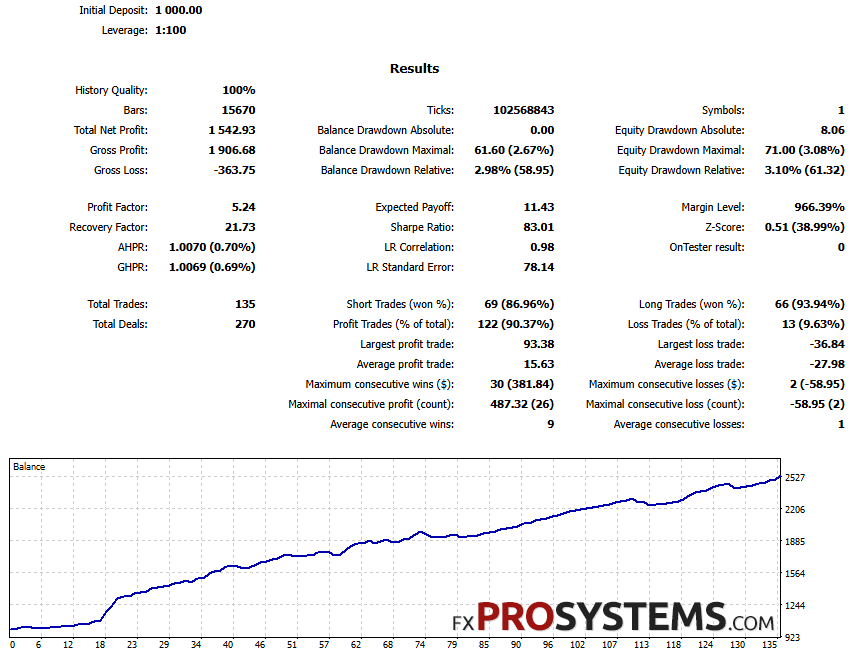
VT Markets | XAUUSD M15 | 2018 – 2026 | $10,000 | Recovery Mode ON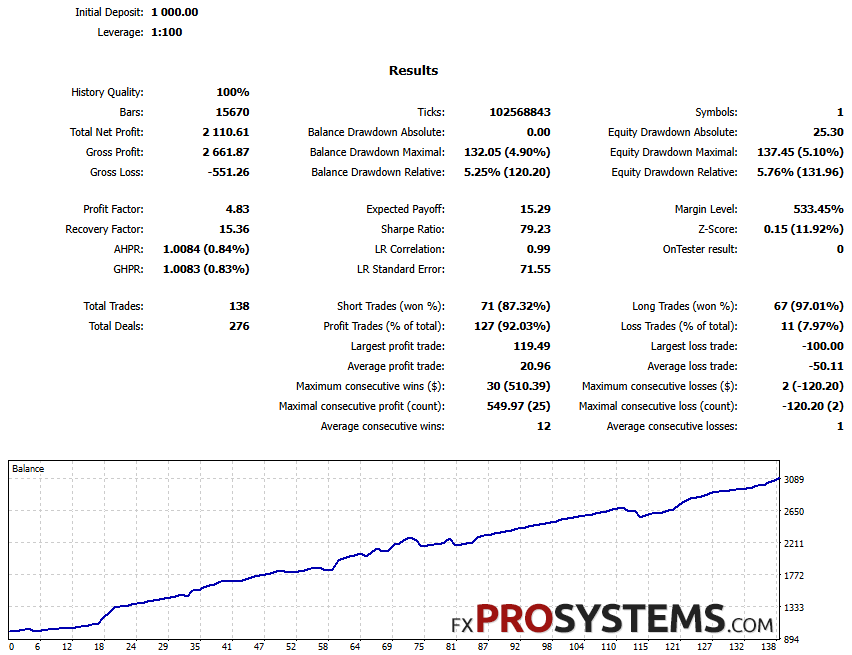
| Metric | MaxDrawdownPercent=1.5, Recovery off | Recovery Mode ON, no DD floor |
|---|---|---|
| Net Profit | $1,542.93 | $2,110.61 |
| Profit Factor | 5.24 | 4.83 |
| Balance DD (relative) | 2.98% | 5.25% |
| Equity DD (relative) | 3.10% | 5.76% |
| Largest loss trade | -$36.84 | -$100.00 |
| Largest profit trade | $93.38 | $119.49 |
| Worst 2-trade losing streak | -$58.95 | -$120.20 |
| Trades / Win rate | 135 / 90.37% | 138 / 92.03% |
| Test period | 2026.01.01–2026.09.01 | 2026.01.01–2026.09.01 |
The Recovery Mode pattern holds even on this smaller sample: the largest loss trade nearly triples (-$36.84 to -$100.00 — 10% of the $1,000 test deposit in a single trade), and the worst losing streak roughly doubles. Trade count and win rate aren't quite identical this time (135 vs 138, 90.37% vs 92.03%) since Recovery Mode's sizing can shift which setups clear the EA's internal filters slightly — but the direction and shape of the effect matches what showed up on the larger, longer-period tests: Recovery Mode fattens both tails, confirmed again on independent data.
On the drawdown floor side: MaxDrawdownPercent=1.5 produced the cleanest result of any test in this article — 2.98% balance drawdown, 5.24 profit factor — but actual equity drawdown (3.10%) still edged past the 1.5% line, so once again the floor's specific trigger behavior isn't clearly demonstrated either way. Nothing about running with a tight floor came at a cost here, on this 8-month window.
Input Parameters of the Quantum Titan EA
Here's the actual settings panel, plain input names and the values used across these tests:
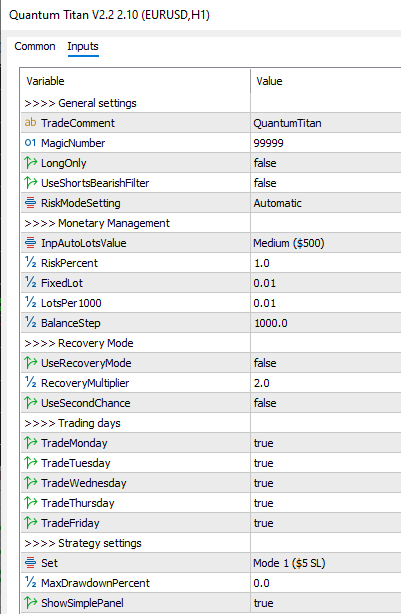
The two inputs that matter most for risk are the two flagged above: UseRecoveryMode, which the testing above confirms behaves like Martingale once switched on, and MaxDrawdownPercent, which ships at 0.0 — no account-level floor at all — unless changed.
The live signal — and a timeline that doesn't hold together
The product page links to a live signal it says started with a €50,000 investment.
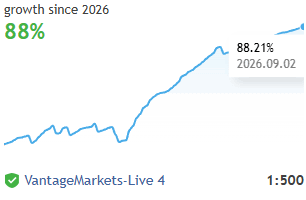
Here are its published statistics, pulled directly from MQL5.
| Metric | Value |
|---|---|
| Initial deposit | €50,000.00 |
| Current balance | €93,266.92 (Growth: 86.53%) |
| Deposits / Withdrawals | €0.00 / €0.00 — clean, no topping-up |
| Trades | 96 (91.66% win rate) |
| Average Profit / Average Loss | +754.10 EUR / -2,886.78 EUR |
| Best trade / Worst trade | +2,391.25 EUR / -2,887.06 EUR |
| Sharpe Ratio | 0.39 |
| Drawdown by Balance / by Equity | 11.81% / 14.59% |
| Avg holding time | 2 minutes |
| Trades per week | 5 |
| Current subscribers | 0 |
| Stated "Started" | 2026.07.25 |
| Stated "Weeks" | 25 |
Start with the good-faith parts. There's no deposit-topping-up pattern here — unlike what was found on the Quantum Queen X signal, deposits and withdrawals both read exactly €0.00, so the 86.53% growth figure is genuine account performance, not padded by injected capital. The win rate is high, and the average loss being roughly 4x the average profit is offset by winning far more often than losing — the math nets out to a real positive expectancy (Expected Payoff +450.70 EUR), not a hidden trap on its own.
Now the part that doesn't reconcile. The page states the signal “Started: 2026.07.25.” That's about five and a half weeks before this article. But the same page's own system log — MQL5's own automated messages, not a vendor claim — contains entries dated well before that. A June 11, 2026 log entry reads that the signal had achieved “80% of growth within 2 days,” describing that as 2.74% of days out of 73 days of the signal's entire lifetime. Seventy-three days before June 11, 2026 is roughly March 30, 2026 — about four months before the “Started” date printed at the top of the same page. Earlier entries go back further still, into late April 2026, each one referencing the account's history as already established at that point.
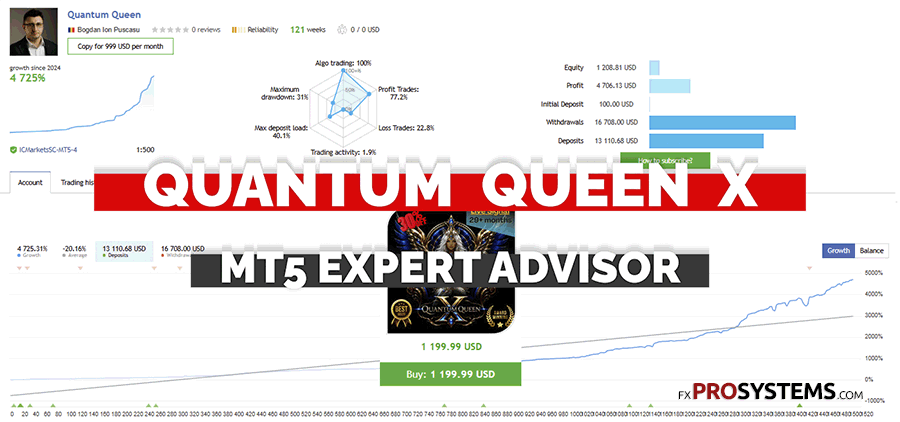
It's not clear which figure is wrong, or why. It could be a display bug tied to how MQL5 recalculates “Started” after some account event, a UI artifact, or something else entirely — there's no way to determine that from outside the platform. What can be said is that this is not a rumor; it's MQL5's own page contradicting itself, in fields anyone can check right now. And it's a strikingly similar shape of problem to what was found on the Quantum Queen X signal, where the “Weeks” field and the “Started” date didn't line up either — this is now the second signal from this same seller with a self-contradictory timeline on the official page.
Also worth flagging on its own: those “80% of growth within N days” warnings recur repeatedly through this signal's log — logged at least five separate times between late April and mid-June 2026. That's MQL5's own concentration warning, essentially the platform confirming the same profit-concentration pattern the structural audit found independently in the backtest: a small number of days carrying most of the result.
Quantum Titan EA vs. Quantum Queen X — different architecture, same playbook
The two products make almost opposite technical claims, and it's worth being precise about that rather than lumping every Quantum product into one basket.
| Field | Quantum Queen X | Quantum Titan EA |
|---|---|---|
| Position structure | Grid baskets, up to 100 legs, individual legs not stopped out | Individually managed trades, up to 2 open at once, each with its own Stop Loss |
| Stated philosophy | The cycle is the unit, not the trade | Every trade protected and evaluated independently |
| Trading frequency | Thousands of trades across the test period | Selective — 5 trades/week on the live signal, some days none |
| Where the risk hides | Uncapped floating loss on baskets that don't close | Profit concentration in a handful of days; a Recovery Mode that behaves like Martingale once enabled |
| Account protection | Account-level DD stop shipped disabled by default | Account-level DD floor (MaxDrawdownPercent) also disabled by default, confirmed across the six tests that left it untouched |
On the specific technical claims, Quantum Titan EA does appear to be a genuinely different construction from Queen X — the structural audit's check found ordinary position stacking (up to 2 at once) rather than grid or Martingale behavior on default settings, and that's measured from the actual deal list, not taken from the marketing copy. Anyone burned by a grid EA's floating-loss mechanic before will find Titan's default architecture is not the same failure mode — though Recovery Mode, once switched on, produces a similar shape of tail risk through a different mechanism.
What is the same: the sales playbook. Both products come from a seller who cross-promotes aggressively across the lineup (“Buy Quantum Titan and get Quantum Emperor or Quantum King or Quantum Bitcoin… for free”), both lean hard on urgency (Titan's capped-license framing, Queen X's launch pricing), and both have a live signal whose headline growth number needs a second look before it's taken at face value — for different reasons in each case: injected deposits on one, an unexplained timeline gap on the other. And by independent count, a third of this seller's historical catalogue (4 of 12 tracked products) is no longer available for sale, for reasons that aren't publicly recorded anywhere — the same pattern being tracked with Quantum Queen specifically.
What could catch a trader off guard in live automated trading
Based on everything above, here's where the gap between the pitch and the lived experience is most likely to show up:
- Execution quality matters more than the marketing suggests. With an edge that evaporates at $0.56 of extra cost per trade, and an average holding time of 2 minutes, the difference between a genuinely low-spread ECN account and anything else isn't a minor detail — it's close to the whole game. This review is a real-world demonstration of exactly this.
- The smooth equity curve is concentrated, not steady. 80% of all profit from 4.4% of active trading days means most days are close to flat, and the strategy's entire track record leans on a handful of outsized winners.
- Recovery Mode is a Martingale switch with a friendlier name. It ships off, but if it ever gets turned on — chasing bigger numbers, or through a preset file that enables it without saying so — the tail risk on individual trades grows several times over, confirmed directly in testing above.
- Long underwater periods are structurally possible. A 709-trading-day drawdown episode in the audited history is close to three years. Nothing about “selective, disciplined, Stop-Loss-protected” prevents a long dry spell — it just prevents any single trade from being catastrophic under default settings.
- Prop-firm use carries broker-specific risk the vendor won't take responsibility for. The developer's own review response makes clear he considers execution-quality complaints the broker's problem, not something Titan is built to compensate for.
- The live signal's own numbers currently contain an unexplained gap. Until that's resolved, the signal's exact growth percentage and timeline should be treated as unverified.
Conclusion
Quantum Titan EA is, on its face, a structurally different product from the grid-based members of the Quantum family — and the backtests confirm it on the point that matters most: the vast majority of trades close via individual stop-loss, with identical trade selection regardless of risk setting on default configurations. No basket closes, no cycle logic. That's a genuine, verified point in its favor.
But “no grid” doesn't mean “no risk,” and the testing surfaced real ones. The account-level drawdown floor (MaxDrawdownPercent) ships disabled by default — the third Quantum product in a row where that's true — and testing it at a tight 1.5% produced a clean, healthy result on its own, though actual equity drawdown in that run still peaked above the 1.5% line, so the floor's real trigger behavior remains only loosely mapped. More definitively: Recovery Mode confirmed exactly what the product page's careful wording was hedging around, on two separate tests at two different deposit sizes. Switch it on, and the largest loss trade roughly triples, reaching 10% of a $1,000 test account in a single trade — a genuinely martingale-shaped mechanism sitting one setting away from “default.” Layer on 87.6% of all profit coming from the last 20 months of an 8.5-year test, the live signal's unexplained timeline gap, and the real-world broker sensitivity the Skif review documented, and the honest picture is: better-built than its grid-based siblings on the specific question of individual trade risk, but with a Martingale-equivalent feature just one toggle away, a drawdown floor that hasn't yet been tested under real stress, and a track record still heavily dependent on the last two years of a gold bull run.
Elementary safety measures before running this live:
- Demo test on the specific broker and account type intended for live use — the review evidence and the broker-comparison testing above both suggest results vary meaningfully by broker
- Leave UseRecoveryMode off unless its risk profile is specifically wanted — confirmed by testing: it roughly triples the largest loss trade in exchange for higher average profit
- Set MaxDrawdownPercent to something rather than leaving it at 0 — testing at 1.5% showed no downside to having it enabled, though the floor's behavior once genuinely triggered still hasn't been observed
- Don't extrapolate too much from the smooth-looking long-term equity curve; nearly 88% of this strategy's entire profit came from the last 20 months of an 8.5-year test
- Use a genuinely low-spread ECN/RAW account and a low-latency VPS — this strategy's edge is measurably sensitive to execution cost
- If considering this for a prop-firm challenge, read the review above in full and weigh the broker-specific slippage risk before committing challenge fees
- Only use capital fully affordable to lose
For stable automated trading, I would recommend taking a look at the Gold Bundle
In the archive Quantum_Titan_EA.rar (66 Kb):
- Quantum Titan V2.2.ex5
Free Download Quantum Titan EA MT5 v2.2