Quantum King EA - same royal family, same grid under the crown

I'll be honest: when I opened Quantum King EA's product page, I'd already met this developer before. This is the same developer behind Quantum Queen — which, just the day before, had wiped out the accounts of many of its users and disappeared from sale on MQL5 — and Quantum Athena, EAs I've picked apart on this site before. Not because Quantum King EA looked alarming — quite the opposite. 231 reviews, a 4.99 rating, 51 purchases a month, and a description that reads like “rule your trading with precision and discipline.” That's exactly what made me want to check whether the family resemblance ran deeper than the branding. I ran tests across three risk presets, on the pair the EA is actually built for. Here's what I found.
Сharacteristics of the Quantum King EA MT5 v3.1
- Official website: MQL5
- Platform: Metatrader5
- EA version: 3.1
- Currency pairs: AUDCAD only — developer explicitly warns against using it on other pairs
- Trading Time: Any / 24h, Sunday–Saturday enabled by default in tested settings
- Timeframe: M5
- Minimum deposit: $300 official minimum, $500+ recommended (my tests used $500) or 1000 USD cents, best conditions here ➔ ProCent
- Recommended broker: Roboforex | VT Markets | XM — ECN/RAW only. 2-decimal GOLD quote. 3-decimal brokers: NOT compatible
- Price: $649.99 — more than the recommended deposit and FREE here ↓
How does it work?
According to the developer, Quantum King EA is built exclusively for AUDCAD on M5, and it “combines the structure of a Grid strategy with the adaptive recovery logic of Martingale.” That's not my interpretation — that's the product page, word for word in spirit. Unlike a lot of EAs I review, this one doesn't hide the mechanism behind vague language like “adaptive AI” or “proprietary scoring engine.” Grid and Martingale are named upfront.



In plain language: when a trade goes wrong, the EA doesn't close it at a loss. It opens another position, usually with a larger volume, hoping the average entry price will let the whole basket close in profit once the market moves back. This is exactly what the order data confirms — every single order I found across all three tests has S/L = 0.00. There is no stop loss on individual trades. The only thing standing between an open basket and your account balance is whichever risk preset you picked and how far price is willing to move against you before turning around.
The developer's own reply to a critical review confirms this directly. In response to a user reporting a 15–20% drawdown, Bogdan explained that Quantum King EA can open multiple positions in the same direction until price reverses, and that some positions can stay open for days or weeks — which he describes as normal for this type of strategy.
Key features (as described / verified):
- Fully automated trading, AUDCAD M5 only —
- Grid + Martingale hybrid with “adaptive control” — confirmed by both the product page and my order data
- 8 risk presets from Very Low to Extreme, selected via a single input (Risco_Preset) — confirmed in the .set files of my tests
- Global basket take-profit measured in pips (Inp_TakeProfit), not per-trade TP — confirmed
- “Works with small deposits — minimum $300” — unverified as a safe claim; see the Testing section below
- “Optimized for long-term stability and capital preservation” — this is marketing language I want to test against the numbers, not repeat as fact
Testing
I ran three independent backtests on RoboForex-ECN, AUDCAD, M5, 2018.01.01–2026.06.30, $500 starting deposit, 100% history quality — one at each of three risk presets the EA exposes: default/low–medium, high, and extreme (the maximum setting available).
One honest observation before the numbers: although all three reports are labeled as an eight-year test starting January 2018, the first actual trade in every single run doesn't happen until January 2, 2020. There are zero trades in 2018 and 2019 across all three tests. I can't say for certain whether that's a data-quality gap on this broker's AUDCAD history or the EA genuinely finding nothing to do for two full years — but it means the “8-year test” claim quietly compresses to a 6.5-year test in practice. That's worth knowing before you look at the balance curve and assume it survived a full market cycle.
Test 1 — Default settings (Risk preset 2 of 7) | $500 deposit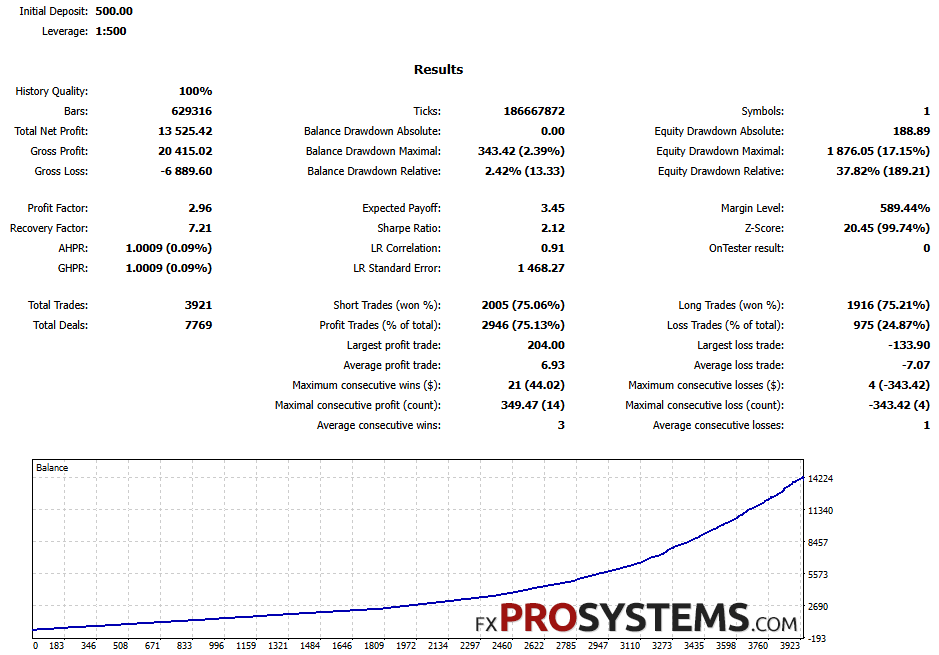
Let's start with the honest picture, because this is the one that actually looks good.
| Metric | Value | Metric | Value |
|---|---|---|---|
| Initial Deposit | $500.00 | Period | Jan 2018 – Jun 2026 |
| Total Net Profit | $13,525.42 | Total Trades | 3,921 |
| Profit Factor | 2.96 | Win Rate | 75.13% |
| Expected Payoff | $3.45 | Sharpe Ratio | 2.12 |
| Balance DD Max | 2.39% ($343.42) | Equity DD Max | 17.15% ($1,876.05) |
| Max Consec. Losses | 4 (-$343.42) | Recovery Factor | 7.21 |
| Largest Profit Trade | $204.00 | Largest Loss Trade | -$133.90 |
| Avg Profit Trade | $6.93 | Avg Loss Trade | -$7.07 |
*Max holding time: 333h 55m (13.9 days).
At default settings, Quantum King EA is genuinely one of the steadier grid EAs I've tested. Profit Factor 2.96 is strong, the balance drawdown never exceeded 2.4%, and the worst losing streak was just 4 trades costing $343 — painful on a $500 account (that's 68.7% of the deposit in one stretch), but recoverable, and it did recover. To be fair about one thing: at this setting, the EA behaves the way the sales page describes it.
Test 2 — High risk (Risk preset 5 of 7) | $500 deposit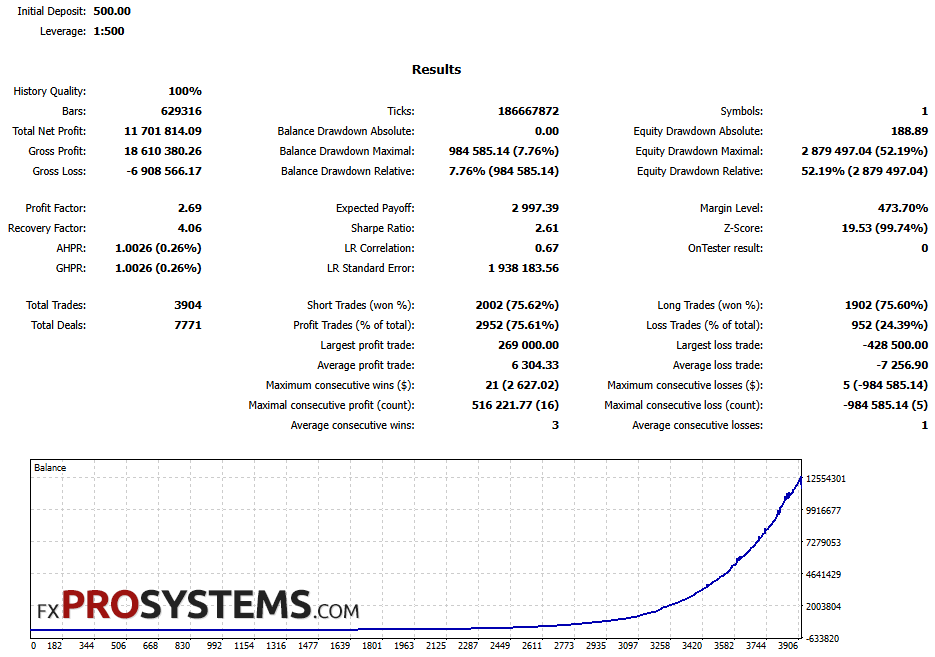
Here's where the picture starts to shift.
| Metric | Value | Metric | Value |
|---|---|---|---|
| Initial Deposit | $500.00 | Period | Jan 2018 – Jun 2026 |
| Total Net Profit | $11,701,814.09* | Total Trades | 3,904 |
| Profit Factor | 2.69 | Win Rate | 75.61% |
| Expected Payoff | $2,997.39 | Sharpe Ratio | 2.61 |
| Balance DD Max | 7.76% ($984,585.14) | Equity DD Max | 52.19% ($2,879,497.04) |
| Max Consec. Losses | 5 (-$984,585.14) | Recovery Factor | 4.06 |
| Largest Profit Trade | $269,000.00 | Largest Loss Trade | -$428,500.00 |
| Avg Profit Trade | $6,304.33 | Avg Loss Trade | -$7,256.90 |
*Max holding time: 333h 55m (13.9 days).
Look at that Net Profit figure again: $11.7 million, from a $500 starting deposit. That number is not a typo, and it's not a triumph either — it's a warning sign wearing a party hat. This is the Auto Lot scaling problem I flagged in the Quantum Queen review, except here it's turned up to a level I haven't seen before. As the account compounds, position sizes grow with it, and by the later years of the test the EA is trading lot sizes no real broker would fill and no real account would survive holding. The dollar figures on the report stop meaning anything the moment the balance crosses into the millions. The blow-up scales with your success.
The part that matters in real trading terms is the 52.19% equity drawdown and a losing streak of 5 trades that, in relative terms, wiped out over 8% of the account balance in one sequence at the point it occurred. That's a high-risk classification by any standard — uncomfortable to watch, not yet catastrophic.
Test 3 — Extreme risk (Risk preset 7 of 7, maximum) | $500 deposit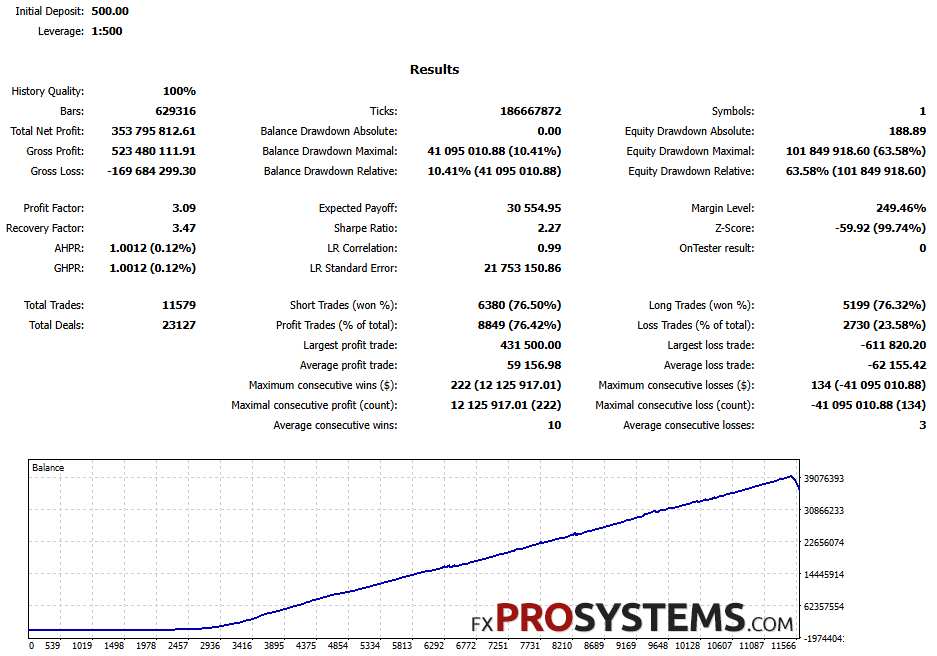
This is the setting the developer exposes but doesn't put on the sales page.
| Metric | Value | Metric | Value |
|---|---|---|---|
| Initial Deposit | $500.00 | Period | Jan 2018 – Jun 2026 |
| Total Net Profit | $353,795,812.61* | Total Trades | 11,579 |
| Profit Factor | 3.09 | Win Rate | 76.42% |
| Expected Payoff | $30,554.95 | Sharpe Ratio | 2.27 |
| Balance DD Max | 10.41% ($41,095,010.88) | Equity DD Max | 63.58% ($101,849,918.60) |
| Max Consec. Losses | 134 (-$41,095,010.88!) | Recovery Factor | 3.47 |
| Largest Profit Trade | $431,500.00 | Largest Loss Trade | -$611,820.20 |
| Avg Profit Trade | $59,156.98 | Avg Loss Trade | -$62,155.42 |
*Max holding time: 333h 55m (13.9 days). Z-Score: -59.92 (statistically anomalous, see below).
134 consecutive losing trades. Read that number twice. My own reference threshold for “this is unmistakably grid or Martingale behavior” is anything above 10 — Quantum King's extreme preset delivers more than thirteen times that. This is the grid doing exactly what a grid does under stress: refusing to close, adding to the position, and waiting. In this test it waited through a losing sequence long enough that the drawdown swallowed over $41 million in a compounded account — a figure that's abstract on paper but represents the exact same proportional risk a $500 account would face on day one.
One more thing worth flagging for anyone comfortable with statistics: the Z-Score came back negative (-59.92) on this run, in a report that otherwise shows a healthy-looking Profit Factor of 3.09. A large negative Z-score alongside a positive profit factor usually means the return distribution is being carried by a small number of extreme outlier trades rather than a repeatable statistical edge — which lines up exactly with what an unconstrained, compounding grid produces. This is how grid math works.
Comparison across all three tests
| Risk preset | Deposit | Net profit | Profit Factor | Max equity DD | Max consec. losses |
|---|---|---|---|---|---|
| Low–Medium (default) | $500 | $13,525.42 | 2.96 | 17.15% | 4 |
| High | $500 | $11.7M* | 2.69 | 52.19% | 5 |
| Extreme (max) | $500 | $353.8M* | 3.09 | 63.58% | 134 |
* Net profit figures for the High and Extreme presets are inflated by uncapped auto-lot compounding on a growing balance and should not be read as realistic outcomes — they're included to show how far the risk scales, not as a return you could withdraw
The pattern across risk presets
There's a clean, consistent story here, and it's the same one Quantum King EA's sales page never quite gets around to telling: profit factor barely moves between presets (2.69–3.09), but risk moves enormously — equity drawdown climbs from 17% to 64%, and the worst losing streak goes from 4 trades to 134. You are not being paid meaningfully more profit factor for the extra risk. You're mostly just being handed more risk.
What happens on other currency pairs?
The developer is explicit that Quantum King is built exclusively for AUDCAD, and I wanted to see what “exclusively” actually means in practice. So I ran the same Medium risk preset, same $500 deposit, same 2018–2026 window, on three other majors: GBPUSD, NZDUSD, and USDCAD. All three accounts were wiped out.
| Pair | Net Profit | Profit Factor | Max DD (bal/equity) | Win Rate | Max Holding Time |
|---|---|---|---|---|---|
| GBPUSD | -$483.07 | 0.44 | 97.81% / 100.13% | 73.74% | 95h 07m |
| NZDUSD | -$472.57 | 0.20 | 95.27% / 95.06% | 65.38% | 564h 50m |
| USDCAD | -$472.96 | 0.70 | 98.01% / 97.56% | 82.13% | 1,619h 10m |
Balance curves, left to right: GBPUSD, NZDUSD, USDCAD — same Medium preset, same $500 deposit, same grid logic that looked fine on AUDCAD
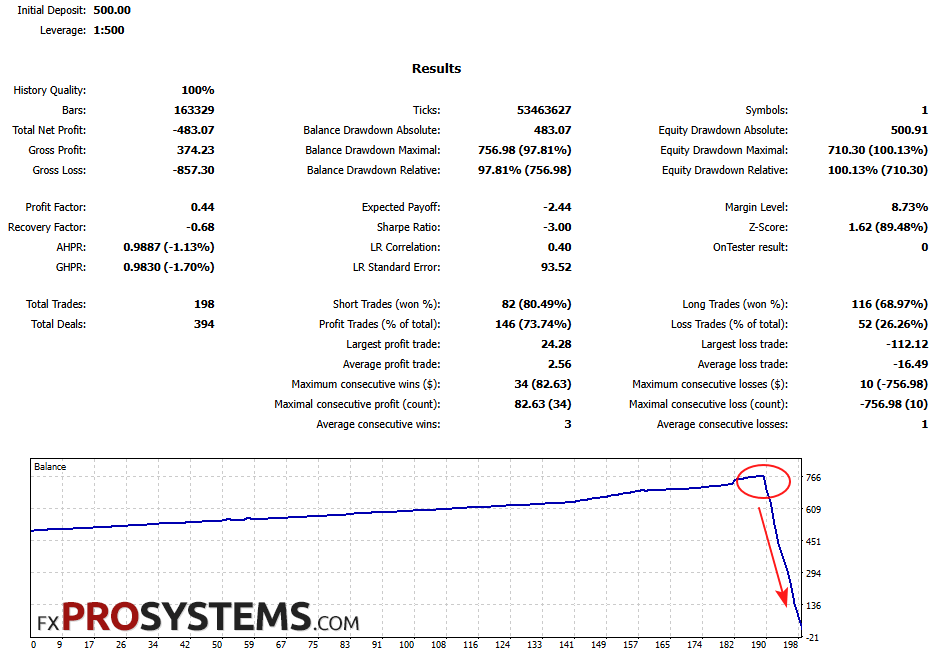
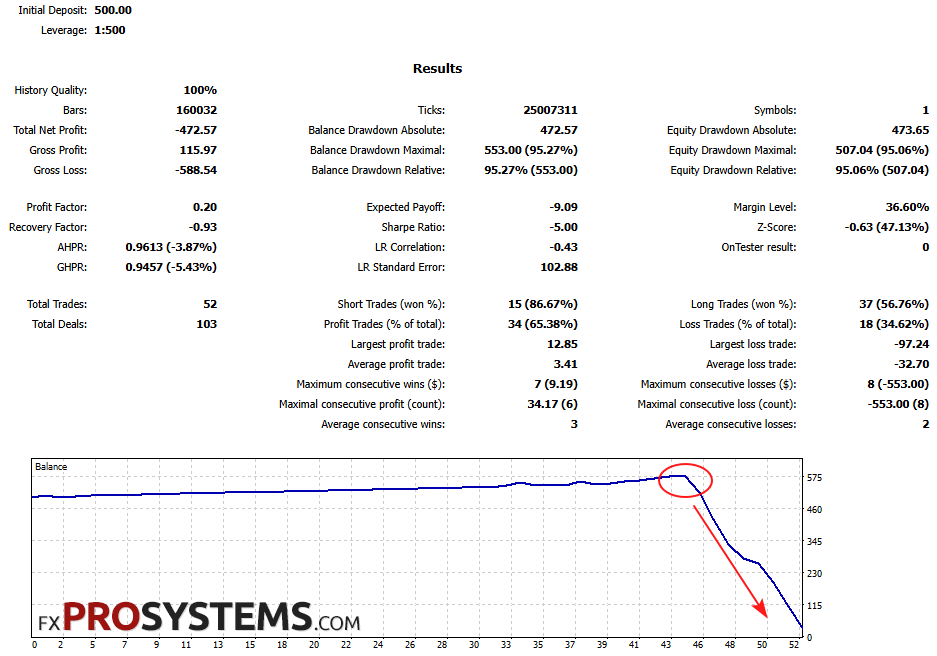
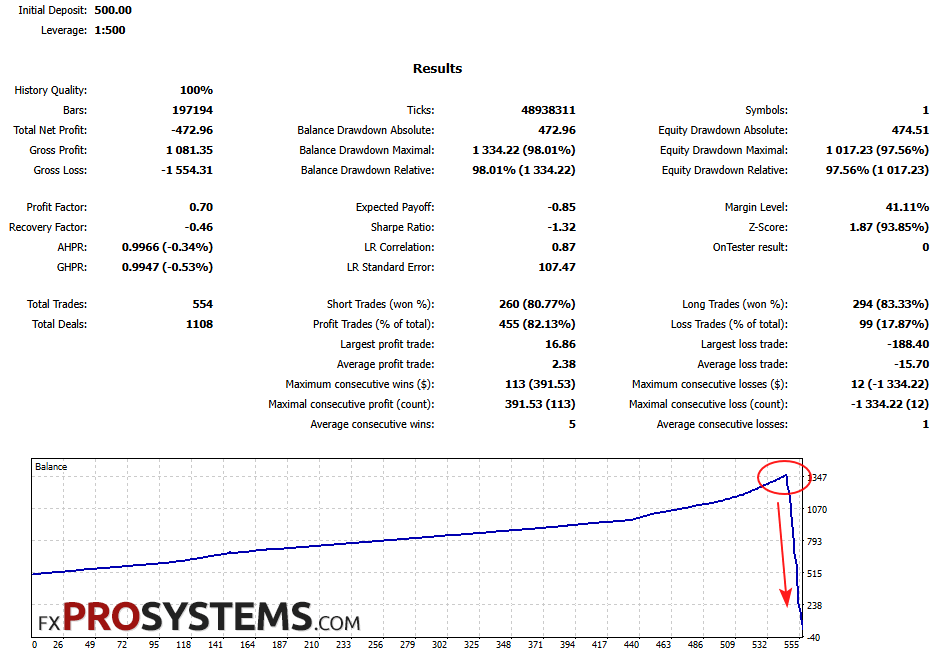
What stands out isn't just that these accounts died — it's how they died. Win rates of 73.74% (GBPUSD), 65.38% (NZDUSD), and 82.13% (USDCAD) — the EA was winning most of its trades on every single pair. It lost anyway, because a handful of losing baskets were large enough to erase everything the winners built. That's not a coincidence or a bad sample; that's the signature of a grid/Martingale system meeting a losing sequence its position sizing wasn't built to survive. Holding times tell the same story: the NZDUSD test held a position open for 564 hours — over 23 days; USDCAD held one for 1,619 hours — more than two months, both well beyond the already-long 333-hour figure I flagged on AUDCAD.
This is the part I keep coming back to: out of an entire universe of tradeable currency pairs, this EA's grid logic only produced a positive outcome on the one pair the developer chose to optimize and market it for. That's not necessarily suspicious on its own — plenty of legitimate strategies are pair-specific. But combined with everything else in this review — no individual stop loss, uncapped position-size scaling, drawdowns that balloon from 17% to 64% just by moving a risk slider — it reads less like “a strategy tuned for AUDCAD’s specific volatility profile” and more like a parameter set curve-fit to survive one historical price path, with no real edge underneath it. I'd treat the AUDCAD-only restriction as a warning label, not a feature.
- No individual stop loss on any trade in any of the three tests (S/L = 0.00 on every order)
- Maximum position holding time of 333 hours 55 minutes — almost 14 days — identical across all three presets
- ❌ 134 consecutive losing trades at the Extreme preset — far beyond the threshold where grid/Martingale behavior is confirmed rather than suspected
- Equity drawdown of 52–64% at High and Extreme presets — high to very-high risk by any standard reference
- Reported “8-year” test period has zero trades in 2018–2019 across all three runs
Quantum King EA Live signal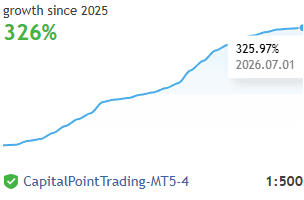
Input Parameters of Quantum King EA
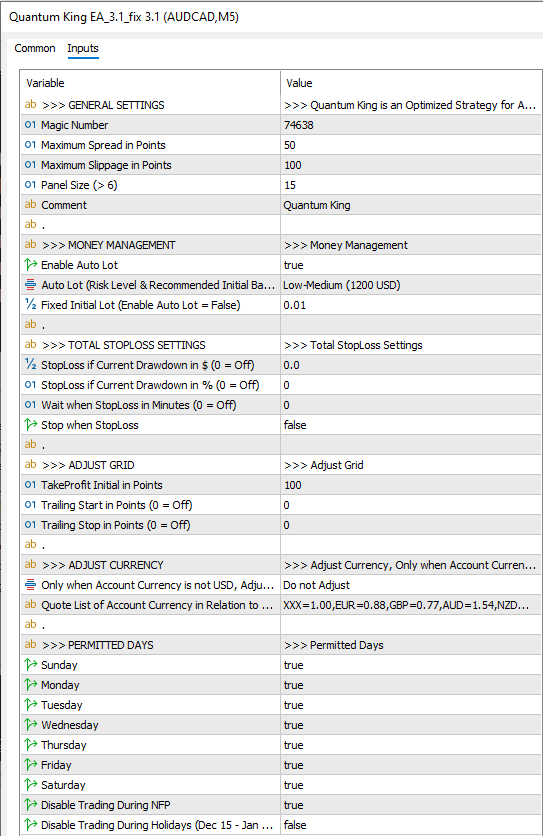
Risk Management
- Risco_Automatico — toggles automatic risk sizing on/off
- Risco_Preset — selects one of 8 risk levels (0 = Very Low … 7 = Extreme). This single input is the one that moved every result in this review from “reasonable” to “alarming.”
- Inp_Lote_Inicial_Manual — manual starting lot size, used only when Risco_Automatico is disabled
Trade Management
- Inp_TakeProfit — basket-level take profit in pips, not a per-trade target
- Inp_BreakEven / Inp_BreakEven_Stop — break-even trigger for the basket
- Inp_Prejuizo_Saldo_Atual / Inp_Prejuizo_Porcentagem_Atual — account-level stop-loss settings (an overall floor, not a per-trade stop) — disabled (Parar_Prejuizo_Atual = false) in every test I ran
Display / Scheduling
- Inp_Tamanho_Painel — on-chart panel size
- Operar_Segunda – Operar_Sabado — which days the EA is permitted to trade
- Disable_NFP_Friday — pauses trading around Non-Farm Payrolls releases
The parameter that matters most for risk control here is Risco_Preset, and specifically Parar_Prejuizo_Atual — the account-level stop-loss toggle, which was set to false (disabled) in every backtest I ran. If you enable Quantum King with defaults from the settings file, you are running it with no account-wide floor and no individual trade stops. The grid is the only risk control.
Conclusion
First and foremost, looking at its predecessor, Quantum Queen EA — which, on the eve of publishing this article (July 1, 2026), wiped out the accounts of many of its users—remember that the same thing may one day happen to Quantum King as well
After running three tests and rereading the sales page a few times, here's where I've landed.
Quantum King is a grid and Martingale hybrid for AUDCAD, and it shares the exact DNA of its sibling Quantum Queen: no individual stop losses, multi-day holding periods, and a risk profile that scales however far you're willing to turn the dial. At default settings, it's genuinely one of the more disciplined-looking grid EAs I've tested — Profit Factor near 3, drawdown under 20%, and losing streaks measured in single digits. The grid is patient. Traders usually aren't.
But the product page doesn't show you preset 7. It doesn't mention that the same engine, with one input changed, produces 134 consecutive losses and a 63% equity drawdown. That's not fraud — it's standard EA marketing to lead with the setting that looks best. My job here is to show you what the other seven settings look like.
Would I trade this on a real account? At the default preset, with the account-level stop loss actually turned on — possibly, and only with money I could afford to see through a multi-week drawdown. At preset 5 or above? No. The extra profit factor you get for that risk is marginal, and the losing streaks stop being a bad week and start being a structural feature of how the strategy handles a losing sequence. Just go in with open eyes.
Elementary safety measures before you run this live:
- Always test on a demo account first — for at least the full length of one grid cycle, not just a few days
- Stick to Low or Medium risk presets; leave High and Extreme for demo curiosity only
- Turn on the account-level stop loss (Parar_Prejuizo_Atual) — it ships disabled
- Withdraw profits regularly rather than letting Auto Lot compound the position size along with the balance
- Use a reliable VPS — a grid holding baskets for up to two weeks cannot afford a dropped connection
- Choose an ECN/RAW broker with genuinely low spreads, as the developer recommends
- Consider a ProCent / cent account if you want to test with real execution conditions at lower absolute risk
If you want your trading to run smoothly with minimal execution delays, you'll need a reliable VPS. For brokers that fit Quantum King's low-spread ECN requirement, IC Markets, Roboforex and XM are worth comparing. If you'd rather test with real execution at low absolute risk, look at a ProCent account before committing a full-size deposit. And whatever preset you choose, open it first on a demo account.
For stable automated trading, I would recommend taking a look at the Gold Bundle
In the archive Quantum_King_EA.rar (541 Kb):
- Quantum King EA_3.1_fix.ex5
Free Download Quantum King v3.1 MT5 EA